Key Takeaways
Your brain treats unfinished conversations like uncompleted tasks: it can't let them go. The Zeigarnik Effect explains why 'let's just drop it' never actually works, and why closing conversational loops is essential for relationship health.
You had an argument three days ago. It wasn't resolved. You both got tired and dropped it. You said "let's just move on." And technically, you did move on. You went to work, made dinner, watched a show together.
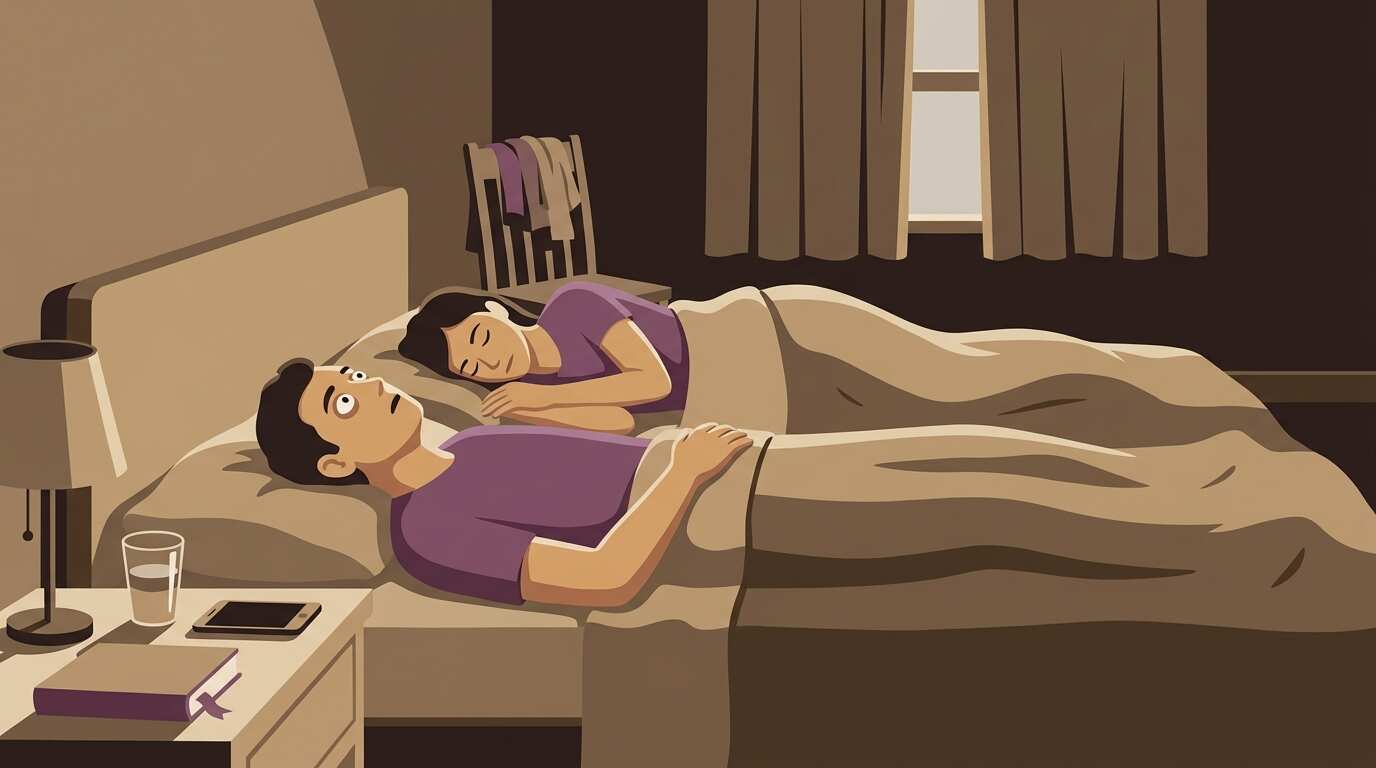
But the argument is still running in the back of your mind. You're composing rebuttals in the shower. You're refining your position during your commute. You're noticing evidence that supports your side. The topic hasn't come up again, but it hasn't gone away either.
There's a reason for this, and it was first documented in a Berlin restaurant in 1927.
Why do unfinished things stick in your head?
Bluma Zeigarnik was a Lithuanian-Soviet psychologist studying under Kurt Lewin in Berlin. The story, possibly apocryphal but too good to fact-check away, is that Lewin noticed waiters in a restaurant could remember complex orders perfectly while the orders were open, but forgot them completely once the bill was paid. The completion of the task erased it from working memory.
Zeigarnik tested this systematically. She gave subjects a series of simple tasks (puzzles, arithmetic, bead-stringing) and interrupted some before completion. When asked to recall the tasks later, subjects remembered the interrupted, incomplete tasks about twice as well as the completed ones.
The finding, now called the Zeigarnik Effect, is this: incomplete tasks create a state of cognitive tension that keeps them active in memory. Your brain treats unfinished business as a priority. It doesn't want to forget it because, from an evolutionary perspective, uncompleted goals still need attention.
This is useful when the unfinished task is "buy groceries" or "reply to that email." Your brain helpfully keeps nudging you. But it's significantly less useful when the unfinished task is "resolve the argument about how we split household responsibilities" or "address the fact that you felt dismissed at dinner last Tuesday."
How does this apply to relationship conflict?
Most relationship conflicts don't end with resolution. They end with exhaustion, interruption, or avoidance. Someone gets too frustrated to continue. The kids need something. It's midnight and you have work tomorrow. Or one person says "I don't want to talk about this anymore" and the other person reluctantly agrees.
The problem is biological. Your brain can't "just drop it" any more than it can forget an uncompleted puzzle. The unresolved conflict creates an open cognitive loop, and that loop keeps running. This shows up as:
Rumination. You replay the conversation, except now you're editing it. You think of better arguments, sharper responses, more effective ways to make your point. Psychologist Susan Nolen-Hoeksema, who spent her career studying rumination, showed that this kind of repetitive negative thinking is strongly associated with depression, anxiety, and relationship dissatisfaction. The loop doesn't just sit there. It actively deteriorates your mental state and your feelings about the relationship.
Resentment accumulation. Each unresolved conflict adds a layer. They don't cancel out or fade with time the way people hope. They stack. And at some point, the stack gets tall enough that a minor disagreement triggers a disproportionate reaction, because you're not responding to this one thing. You're responding to the entire unresolved pile. For more on how this builds, see the post on resentment in relationships.
Negative story-building. While the loop runs, your brain doesn't just replay facts. It constructs narratives. "They always dismiss me." "They never listen." "They don't respect my feelings." These narratives harden with each repetition. By the time you do revisit the original topic, you're not discussing one incident anymore. You're prosecuting a pattern you've spent days building a case for.
Emotional flooding during unrelated conversations. An unresolved conflict about finances can make a conversation about vacation plans feel threatening. The open loop creates a background emotional charge that attaches to adjacent topics. You end up fighting about where to go for dinner when the actual issue is something you agreed to drop a week ago.
Why doesn't "let's just drop it" work?
Because you can't voluntarily close a cognitive loop. That's the whole point of the Zeigarnik Effect. The closure has to come from somewhere.
Gottman's research on relationship conflict supports this directly. His team found that 69% of relationship conflicts are perpetual, meaning they never fully resolve because they're rooted in fundamental personality or value differences. But he also found that the couples who handled perpetual conflicts well didn't resolve them. They processed them. They talked about them regularly, understood each other's positions, and reached a place of mutual acceptance even without agreement.
The couples who handled them badly did exactly what feels natural: they avoided the topic, shut down the conversation when it got uncomfortable, or declared it settled when it wasn't.
"Let's just drop it" is the relational equivalent of closing a program without saving. The work isn't gone. It's just been moved to a place where it's harder to access and more likely to cause problems.
What's the difference between an open loop and an unresolvable difference?
This matters. Not every disagreement has a resolution, and pretending otherwise creates its own problems.
An open loop is a conversation that has a possible endpoint but hasn't reached it. One person said something hurtful and hasn't acknowledged it. A decision needs to be made and keeps being postponed. Someone's feelings were dismissed and that dismissal hasn't been addressed. These have closure available. The conversation just hasn't gotten there.
An unresolvable difference is a genuine incompatibility that won't go away through talking. You want to live in the city; they want the suburbs. You want three kids; they want one. You're an introvert partnered with someone who needs to socialize every weekend. These can't be "closed" in the traditional sense.
But even unresolvable differences can be processed into a state that doesn't create cognitive loops. The loop closes not when you agree, but when you both feel fully heard and understood. When you can say "We disagree about this, and I understand why you feel the way you do, and I feel understood by you in return," the cognitive tension releases. The brain doesn't need agreement. It needs completion. And being genuinely heard is a form of completion.
How do you close an open conversational loop?
Several approaches work, depending on the situation.
The completion conversation
This is the most direct approach. You go back to the thing that was dropped and finish it. Not to re-argue. To reach a conclusion, even if that conclusion is "we see this differently and that's okay."
The key difference from the original argument: you're not trying to win. You're trying to close. The goal is for both people to feel that their position was understood and their feelings were acknowledged.
A useful structure:
- "I want to go back to what we were talking about on Tuesday, not to fight about it, but because I realize we didn't finish."
- Each person states their perspective without interruption.
- Each person reflects back what they heard: "So what you're saying is..."
- Identify what, if anything, needs to happen next.
- Explicitly name the conversation as complete: "I feel like we're in a better place on this. Do you?"
That last step sounds artificial but it matters. Remember, the brain needs a signal that the task is done. Paying the bill, as in Zeigarnik's restaurant metaphor.
If you're not sure how to revisit a difficult topic without reigniting it, the post on repair conversations after a fight has a practical framework.
The 48-hour rule
Some couples find it helpful to set a boundary: any conflict that gets tabled must be revisited within 48 hours. Not immediately. You're allowed to take a break, cool down, and gather your thoughts. But not indefinitely.
The 48 hours is somewhat arbitrary, but the principle is sound. Short enough that the details haven't been distorted by days of rumination. Long enough that the initial emotional flooding has subsided. It prevents the dangerous drift where "we'll talk about it later" becomes "we'll never talk about it again."
Both partners need to agree to this, and it has to be bidirectional. If only one person initiates the revisit, the pattern becomes one person pursuing and the other being dragged back to uncomfortable topics.
Journaling as a partial close
When you can't have the conversation yet (or when the other person isn't available or willing), writing down your thoughts provides a partial closure. Research by James Pennebaker at the University of Texas has shown that expressive writing about emotionally charged events reduces intrusive thoughts and improves psychological well-being.
It's not a full substitute for the interpersonal conversation. The loop involves another person, and full closure usually requires their participation. But journaling reduces the intensity of the rumination. It takes the thoughts out of the spinning-in-your-head stage and puts them somewhere concrete, which gives your brain a partial sense of completion.
Structured check-ins
Some couples build a regular practice of clearing out open loops before they accumulate. A weekly "relationship check-in" where both people can raise unfinished business prevents the stack from growing too tall.
This doesn't have to be heavy. It can be as simple as "Is there anything from this week that we should talk about?" The regularity of it means that small irritations get addressed at the small-irritation stage, before they've been amplified by days of rumination into major grievances.
Asking each other intentional questions on a daily basis serves a similar function on a smaller scale. Aperi gives couples a daily question specifically designed to keep communication lines open, which naturally prevents loops from staying unaddressed for long.
What do you do when your partner refuses to revisit?
This is the hardest version of the problem. You have an open loop that's generating rumination, resentment, and emotional flooding. But your partner won't re-engage. They've decided the conversation is over, and bringing it up again gets met with "We already talked about this" or "I don't want to argue again."
A few thoughts:
Distinguish between "not now" and "not ever." If your partner needs more time, that's reasonable. If they're categorically refusing to ever discuss a topic that matters to you, that's a different problem. The first requires patience. The second may require professional help.
Explain the Zeigarnik Effect, literally. Sometimes people refuse to revisit conflicts because they believe the kind thing is to let sleeping dogs lie. Explaining that your brain genuinely can't let it go, that it's not a choice or a preference but a cognitive mechanism, can change their willingness to engage. You're not being dramatic. You're being human.
Focus on what you need, not what they did. "I need to feel like you understand why that hurt me" is more likely to re-open a conversation than "You need to admit you were wrong." The first is a request for connection. The second is a demand for capitulation.
Consider whether the pattern is bigger than this one incident. If your partner consistently refuses to process conflict, that itself is the issue, bigger than any individual disagreement. Persistent stonewalling is one of Gottman's "Four Horsemen" and predicts relationship failure with high accuracy. This is the kind of thing couples therapy was designed for.
The post on having hard conversations without it turning into a fight goes deeper on approaching these situations.
Does this explain why couples keep having the same fight?
Partly, yes. The recurring fights phenomenon has multiple causes, but unresolved cognitive loops are one of them. When a conflict gets dropped without processing, it doesn't go back to zero. It goes to standby. And it gets reactivated easily: by a similar situation, a related topic, a tone of voice that echoes the original argument.
Each reactivation adds frustration, because now you're not just dealing with the current instance. You're dealing with the accumulated memory of every time this topic was raised and never resolved. The fight escalates faster than the current situation warrants because it's pulling energy from all the previous incomplete iterations.
Breaking the cycle requires changing the ending. The fight itself may be repetitive. But if even one iteration ends with genuine processing and mutual understanding rather than exhaustion and avoidance, the loop weakens. The brain gets its signal of completion, and the next occurrence of the same issue starts from a lower baseline of tension.
The cost of leaving things unsaid
Unspoken feelings are open loops too. You don't have to argue about something for it to occupy your mind. An unexpressed appreciation, an unshared worry, an unasked question: these all create low-grade cognitive tension that accumulates over time.
Couples in long-term relationships often develop a backlog of unspoken things. Some are small: "I wish you'd noticed how hard I worked on that dinner." Some are large: "I'm scared about what happens to us when the kids leave." The assumption is that if it hasn't been said by now, maybe it shouldn't be. But the Zeigarnik Effect suggests those things are still taking up space, still running in the background, still subtly shaping how you experience the relationship.
Saying the thing closes the loop. Even if the response isn't what you hoped for. Even if it opens a new conversation. The open loop is almost always worse than the conversation you're avoiding.
FAQ
Is the Zeigarnik Effect always active, or just during stress?
The effect is a general property of memory and cognition, not dependent on stress. However, stress amplifies it. When you're already taxed, your brain has fewer resources to suppress the intrusive thoughts generated by unfinished business. So while the Zeigarnik Effect operates all the time, its impact on your relationship will be most noticeable during high-stress periods.
Can you resolve someone else's open loop for them?
Not entirely. You can contribute to closing it by engaging in the conversation they need, by acknowledging their feelings, by offering the apology or explanation they're waiting for. But you can't force their brain to release the tension. If someone isn't satisfied by a conversation, the loop stays open for them regardless of your intentions. This is why checking in ("Do you feel like we're in a good place on this?") matters.
How do I know if something is an open loop or if I'm just overthinking?
If you keep returning to the same thought without choosing to, it's likely an open loop. Voluntary reflection ("I'm going to think about what happened to understand my feelings") is different from involuntary rumination ("I can't stop replaying what they said"). The second one suggests unfinished cognitive business that needs resolution, whether through conversation, journaling, or professional support.
My partner says they've moved on but I haven't. Now what?
Your brain doesn't close loops on your partner's schedule. If they've processed it and you haven't, you still need to finish. Tell them directly: "I know you feel resolved on this, but I'm still thinking about it. Can we talk about it one more time, not to re-argue but so I can get to where you are?" Most partners will say yes to that request when it's framed as a need for closure rather than a desire to reopen the fight.
Aperi: one question a day
A daily question app that adapts to you and your partner, and goes deeper the more you use it.


Free to start. Available on iPhone and Android.
Explore question packs
Related articles

When you and your partner speak different love languages
You show love your way, not theirs. How to close the gap when you and your partner express affection differently, beyond the quiz.

ADHD and relationships: what both partners need to know
ADHD doesn't just affect focus. It reshapes relationship dynamics in ways both partners need to understand to stop the blame cycle.

The mental health conversation every couple needs to have
Why mental health is a relationship topic, how to bring it up, and how to build a mental health plan as a couple.

Active listening: the most underrated relationship skill
What active listening really means, why most people get it wrong, and specific techniques backed by decades of research.

Rebuilding trust after it's been broken
Trust isn't rebuilt by promises. It's rebuilt by changed behavior over time. Here's what the research says about the process.
Emotional regulation: the skill that saves relationships
Emotional regulation is the most underrated relationship skill. How it works, why suppression backfires, and what to do when you're flooded.