Key Takeaways
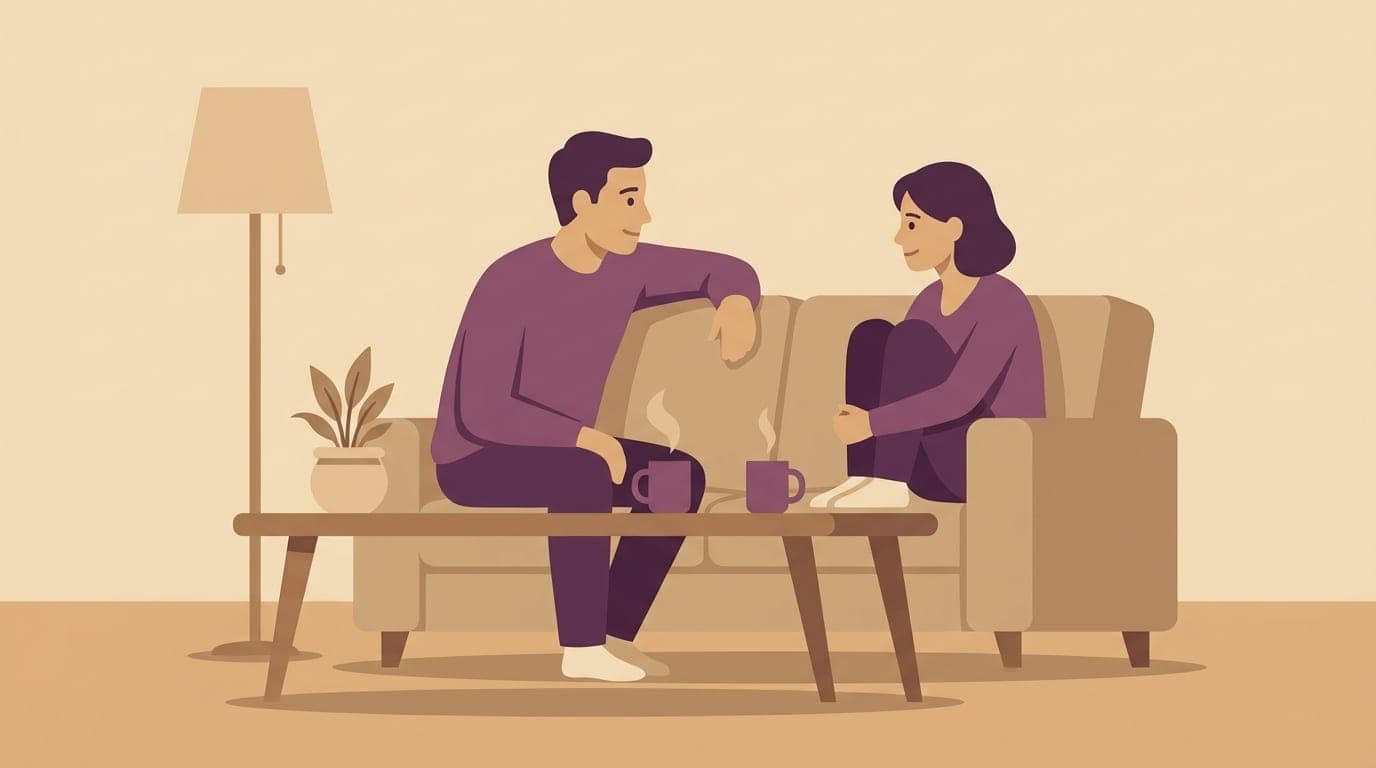
The conversation after a fight matters more than the fight itself. These 25 questions are organized into 4 phases (understanding, responsibility, repair, and prevention) to help you actually learn from conflict instead of repeating it.
Why the Conversation After Matters More Than the Fight
Most relationship advice focuses on how to argue better. Fair enough. But John Gottman, after studying thousands of couples over four decades at the University of Washington, found something that shifts the focus: it's the conversation after the fight that predicts whether a couple stays together.
He calls it "aftermath of a fight" processing. The idea is straightforward. During an argument, you're both flooded with emotion. Your heart rate is up. Your prefrontal cortex, the part of your brain responsible for empathy, perspective-taking, and rational thought, is partially offline. You're in fight-or-flight mode. Nothing productive happens there.
The real work happens later. When you're calm, when the adrenaline has cleared, when you can actually hear each other. That's when you figure out what the fight was really about (it's almost never about the dishes), take responsibility for your part, and decide how to handle it differently next time.
The problem is most couples skip this step entirely. The fight ends, someone apologizes or you both just move on, and the underlying issue sits there like a landmine waiting to go off again. That's how couples end up having the same argument for fifteen years.
When to Have This Conversation
Timing matters a lot here. Gottman's research on physiological flooding shows that when your heart rate exceeds roughly 100 beats per minute, your ability to listen and empathize drops off a cliff. It takes at least 20 minutes for the stress hormones to clear your system. Some people need longer.
So don't try to process a fight 10 minutes after it happened. You're not calm yet. Your body is still in defense mode, even if your brain thinks it's ready.
Wait until both of you genuinely feel settled. That might be an hour later, or it might be the next morning. There's no shame in saying, "I want to talk about this, but I need some time first. Can we come back to it tonight?"
When you do sit down, the goal isn't to relitigate. You're not trying to prove your point or win the argument retroactively. You're trying to understand what happened, emotionally, not just factually.
How to Use These Questions
Don't fire all 25 at your partner. Pick the ones that feel relevant to what just happened. Maybe you start with one or two from the understanding section, move to responsibility, and see where it goes.
Take turns. Listen without interrupting. If you feel yourself getting defensive again, that's a signal to slow down, not speed up. You can always pause and come back.
These are for the hours after a fight. For the calmer days in between, questions to ask your girlfriend and its boyfriend counterpart run from light to deep.
One more thing: these questions assume both people are acting in good faith. If your partner is dismissive, contemptuous, or unwilling to engage, that's a bigger issue than one conversation can fix. Couples therapy might be the right next step.
Understanding What Happened
The first job is to figure out what was actually going on beneath the surface. Most fights have a stated topic (the dishes, being late, the comment at dinner) and an actual topic (feeling unappreciated, disrespected, or alone). These questions dig into the second layer.
- What were you feeling when the argument started? Not what you were thinking, what you were feeling.
- Was there a specific moment when things shifted from a conversation to a fight?
- What did I say or do that hurt you the most?
- Did this argument remind you of anything from your past, with me or before me?
- What were you actually trying to tell me underneath the frustration?
- Did you feel heard at any point during the argument, or not at all?
- Was there something you wanted to say but held back?
Gottman's research found that 69% of relationship conflicts are "perpetual problems," recurring disagreements rooted in personality differences or fundamental needs. If the same fight keeps coming back in different clothes, it's worth asking whether there's a deeper incompatibility you need to address rather than a problem you need to solve.
Taking Responsibility
This is the hard part. It's much easier to focus on what your partner did wrong than to look at your own contribution. But repair doesn't work without ownership.
The psychologist Harriet Lerner, in her book Why Won't You Apologize?, argues that a real apology doesn't include the word "but." It doesn't explain your behavior. It doesn't redirect blame. It just acknowledges impact.
These questions help you get honest with yourself.
- What did I do that made things worse?
- Is there something I should apologize for, specifically?
- Did I say something I didn't mean?
- Did I listen to you, or was I just waiting for my turn to talk?
- Was I fighting to be right, or fighting to be understood?
- Is there a pattern in how I act during arguments that I need to look at?
A genuine answer to "Was I fighting to be right?" is one of the most uncomfortable and useful things you can ask yourself. Most of us default to debate mode in conflict. We build a case, marshal evidence, and try to win. But your partner isn't opposing counsel. If you "win" and they feel unheard, you both lose.
Repair
Once you've understood the hurt and owned your part, repair is about reconnecting. Not pretending the fight didn't happen. Not rushing to "we're fine." Actually tending to whatever got damaged.
Gottman calls these "repair attempts" and considers them the single most important factor in relationship stability. What matters is whether you can find your way back to each other after, not whether you fight.
- What do you need from me right now?
- Is there something I can do to help you feel safe again?
- Do you feel like we've gotten to the real issue, or is there more?
- Is there anything you need to hear from me?
- Can you tell me one thing I did during the argument that was okay or helpful?
- What would help you feel like we're on the same team again?
- Do you need more space, or do you need closeness right now?
Question 20 matters more than it seems. After a fight, some people want a hug. Others need to be left alone for a while. Assuming your partner wants what you want is a common source of post-argument friction. Just ask.
Prevention
The point of processing a fight isn't just to feel better. It's to learn something. These questions turn a painful experience into information you can use.
- Is there a way we could have raised this issue before it became a fight?
- Was there a point where we could have paused and de-escalated?
- Do we need a signal for when one of us is too flooded to keep talking?
- How can I bring this kind of thing up in the future without it feeling like an attack?
- Is there a need of yours that I've been missing?
Question 23 is worth spending time on. Many couples benefit from having a literal safe word or gesture that means "I'm overwhelmed and I need 20 minutes." It's not avoidance. It's the opposite. It's a commitment to come back and engage when you can actually do it well.
Question 25 might be the most important one on this list. Sometimes what looks like a fight about chores is actually about someone feeling invisible. Sometimes what looks like jealousy is actually about feeling insecure. The need underneath the conflict is almost always more important than the conflict itself. If you can name it, you can address it directly instead of playing whack-a-mole with symptoms.
For a more detailed framework on having hard conversations without things escalating, that post goes deeper into setup and structure. And if you find that your arguments keep following the same pattern, one person pursuing and the other withdrawing, the pursuer-withdrawer dynamic is worth understanding.
The Bigger Picture
Conflict in a relationship isn't a sign that something is wrong. Every couple fights. Gottman's research consistently shows that the type of conflict matters far more than the amount, and that high-conflict and low-conflict couples can both be stable as long as they repair. Couples who stay happy don't avoid disagreements. They process them.
The questions above are a starting point. Over time, you'll develop your own version of this conversation. You'll learn which questions your partner responds to and which ones shut them down. You'll get faster at the cycle of understanding, responsibility, repair, and prevention.
Something worth noting: this gets easier with practice. The first time you sit down to process a fight, it feels awkward. You're not used to it. The language feels stiff. That's normal. By the fifth or sixth time, you'll have your own shorthand. You'll know that your partner needs to be heard first before they can hear you. Or that you need to take responsibility before you can receive it. Those patterns emerge from doing this work repeatedly.
The couples who struggle most are the ones who never have this conversation at all. They fight, they cool off, they act normal, and they quietly add another brick to the wall of resentment. If you're reading this and realizing you've been doing that, here's how to start dismantling that wall. It's not too late, but the longer the resentment sits, the harder the conversation becomes. Better to start now with something small than to wait until the weight of unprocessed fights becomes too heavy to carry.
If you want to build a regular habit of checking in before tensions build up, Aperi's Conflict to Connection pack offers daily prompts designed to keep small issues from becoming big fights. It's easier to ask "how are we doing?" every day than to figure out "what went wrong?" after a blowup.
FAQ
What if my partner won't engage with these questions?
Don't push it. You can say, "I want to understand what happened. When you're ready, I'd like to talk about it." If they consistently refuse to process conflict, that's a pattern worth naming, gently. Stonewalling is one of Gottman's "Four Horsemen" that predicts relationship breakdown, so it's not something to ignore.
How long should we wait after a fight to have this conversation?
At least 20 minutes, based on the research on physiological flooding. But there's no upper limit. If you need a day, take it. The only wrong answer is never having the conversation at all.
What if we start fighting again while processing the original fight?
Stop. That's your body telling you you're not actually calm yet. Say something like, "I think we're getting activated again. Let's take a break and try again later." There's no rule that says you have to finish in one sitting.
Should we apologize before or during this conversation?
Both are fine, but an apology that comes after genuine understanding is usually more meaningful than one that comes before. "I'm sorry I raised my voice" hits differently when it follows "I realize you were already feeling dismissed and I made it worse." There is more on what makes an apology land if yours keep getting waved away.
Can we use these questions over text?
In person is better. Tone gets lost over text, and these conversations need nuance. But if you're long-distance or need the safety of having time to think before responding, writing can work. Just be intentional about it. Don't text question 3 while your partner is in a meeting.
Aperi: one question a day
A daily question app that adapts to you and your partner, and goes deeper the more you use it.


Free to start. Available on iPhone and Android.
Explore question packs
Related articles
Lack of communication in a relationship is rarely a skills problem
Lack of communication in a relationship: what the breakdown looks like in practice, what causes it (rarely skills), and the scripts that rebuild it.
50 couples therapy questions, in the order a therapist would ask them
50 couples therapy questions sequenced like a real session: history, patterns, needs, repair, future. Plus an honest look at when a list is not enough.
Questions for couples who feel stuck
30 questions for couples who feel stuck, organized by difficulty. Start with safe questions and work toward the things you have been avoiding.
Check-in questions for couples: daily, weekly, monthly, yearly
Check-in questions for couples sorted by cadence: daily two-minute rounds, weekly check-ins, monthly resets, and the annual review, each with a short script.
67 uncomfortable questions to ask your partner and the ground rules that keep them safe
Uncomfortable questions to ask your partner: 67 honest but gentle prompts, plus how to ask consent, pick your moment, and repair if one lands badly.
Hard questions to ask your partner before life asks them for you
Hard questions to ask your partner about money, family, fears, and the future: 63 serious prompts, plus how to time them so honesty builds trust.