Key Takeaways
Your partner s childhood shaped how they love, fight, and feel safe. These 35 questions help you understand that history without turning dinner into a therapy session.
Why Does Their Childhood Matter to Your Relationship?
Every person you date comes with roughly two decades of backstory you weren't there for. That backstory didn't stop shaping them when they turned eighteen. It's running in the background right now, influencing how they argue, how they show love, what makes them shut down, and what makes them light up.
John Bowlby's attachment theory established this decades ago: children form "internal working models" of relationships based on their early caregiving experiences. These models are essentially blueprints. They tell your partner what to expect from closeness, whether conflict is safe, and what love should feel like. Updated research from R. Chris Fraley and others shows these models remain surprisingly stable into adulthood, though they can shift through secure relationships and intentional work.
Then there's the ACEs research. The Adverse Childhood Experiences study, originally conducted by Vincent Felitti and Robert Anda in the late 1990s, found that childhood adversity doesn't just affect mental health. It predicts adult relationship patterns, communication styles, and even physical health outcomes. A partner who grew up in a chaotic household may have a finely tuned radar for conflict. One who experienced neglect might struggle to ask for what they need.
None of this is deterministic. People aren't prisoners of their childhoods. But understanding where your partner came from gives you context for who they are now. And that context changes how you respond to them in the moments that matter most.
How Do You Ask Without Making It Feel Like an Interrogation?
These aren't questions to rapid-fire across the dinner table. They're conversations to ease into, probably over multiple sittings. A few ground rules:
Let them set the pace. If your partner grew up in a home where everything was fine, these questions might flow easily. If they didn't, some of these will land in tender spots. Watch for signs they're getting overwhelmed: shorter answers, shifts in body language, sudden deflection to humor. When you see those signs, slow down or stop.
Don't compare. "Oh, my childhood was like that too" can feel connecting or minimizing depending on delivery. When your partner shares something hard, resist the urge to immediately map it onto your own experience. Sit with theirs first.
Don't fix. This is the big one. When someone tells you about a painful childhood experience, the instinct is to say something reassuring: "But you turned out great" or "At least you learned from it." Those responses close the conversation. A better response: "Thank you for telling me that. What was that like for you?"
Don't judge their family. Even if your partner is sharing something genuinely terrible about a parent, they probably have complicated feelings about it. Saying "Your dad sounds awful" might feel validating, or it might feel like an attack on someone they still love. Let them lead on how they frame their own family.
Know when to stop. Some childhood material is better processed with a therapist than a partner. If a question surfaces something your partner has never talked about before and the emotion feels bigger than the conversation can hold, it's okay to say: "I'm glad you shared that with me. Would it help to talk to someone who's trained in this?"
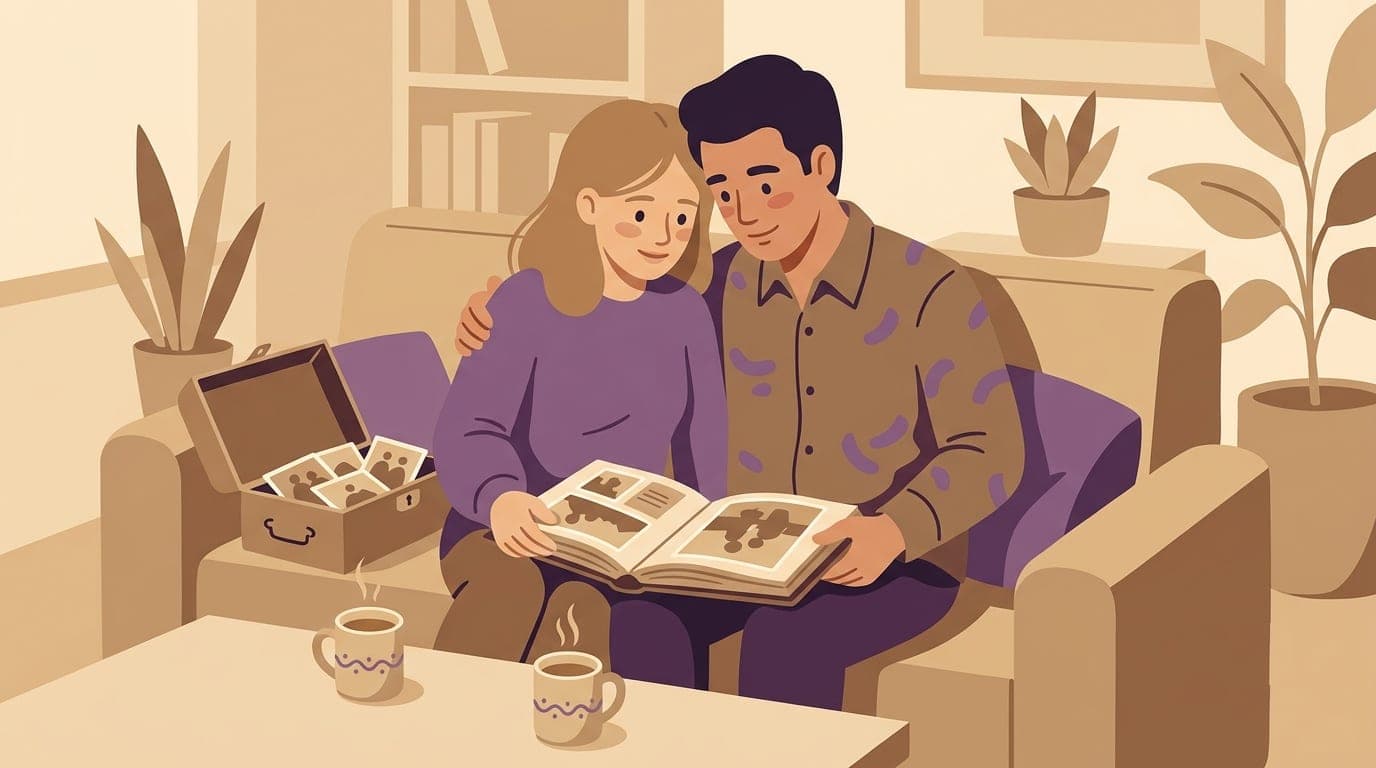
Happy Memories
Start here. These questions are warm, low-stakes, and often funny. They build the feeling of safety you'll need for the harder sections.
- What's the happiest single memory you have from childhood?
- What did you want to be when you grew up, and when did that change?
- What was your favorite meal that someone in your family made?
- Did you have a best friend? What were they like?
- What games did you play? What did a typical summer day look like?
- Was there a teacher or adult outside your family who really saw you?
- What was your most prized possession as a kid?
- What's a family tradition from childhood that you actually enjoyed?
- Where did you feel safest?
These answers often contain more than they seem to. Where someone felt safest tells you what safety means to them. What they wanted to be reveals what they valued before the world started editing their dreams.
Family Dynamics
This is where you start learning about the system your partner grew up inside. Every family has unspoken rules, assigned roles, and power dynamics. These questions surface them.
- How would you describe each of your parents in three words?
- Who made the decisions in your family?
- What were the unspoken rules in your house?
- How did your family handle conflict? Yelling? Silence? Pretending nothing happened?
- Were emotions talked about openly, or did everyone keep things to themselves?
- What role did you play in your family? The responsible one? The peacemaker? The invisible one?
- How did your parents show love to each other? To you?
- Was there a family member you were particularly close to? One you struggled with?
- What was dinnertime like?
That last question sounds simple. It's not. Dinnertime tells you whether a family connected, whether a household felt tense or relaxed, whether conversation was expected or suppressed. Don't skip it.
How to receive these answers: Your partner's description of their family dynamics might sound nothing like your own experience. That gap is information. It explains differences in how you two approach everything from holiday planning to arguments about dishes. Listen for patterns, not judgments.
Formative Experiences
These questions go deeper. They ask about moments that changed something. Proceed gently.
- What's the hardest thing you went through as a kid?
- Was there a moment when you felt like you had to grow up fast?
- Did you ever feel like you didn't belong? Where? When?
- What's something that happened in childhood that you think about more as an adult than you did at the time?
- Did your family go through a major change (move, divorce, loss, financial hardship)? How did that affect you?
- What were you most afraid of as a child?
- Was there a time when you needed help and didn't get it?
- What's something a parent or caregiver said to you that stuck?
A note on question 25. This one can surface real pain. If your partner answers it with something significant, don't rush past it. And don't immediately try to be the person who "makes it better." Sometimes the most powerful thing you can do is just witness what they're telling you.
What You Carried Into Adulthood
These questions connect past to present. They're the bridge between "what happened to you" and "how you show up in our relationship."
- What did your childhood teach you about love?
- What's a belief from childhood that you've had to unlearn?
- How has your relationship with your parents changed since you became an adult?
- What's something from your childhood you want to pass on to your own kids (or to the people you're close to)?
- What's something you would never repeat?
- How do you think your childhood affects the way you handle conflict now?
- What's a coping mechanism from childhood that still shows up?
- When you feel stressed or threatened, where does your mind go? Can you trace that back to anything?
- What do you wish your partner (me) understood about where you come from?
Question 35 is the one that matters most. It's an explicit invitation: tell me what context I'm missing. The answers to this question have changed relationships.
When a Conversation Isn't Enough
Some childhood experiences are too heavy for a partner to hold alone. Trauma, abuse, severe neglect, addiction in the family, loss of a parent. These things deserve professional support.
If your partner's answers point to unresolved trauma, suggesting therapy isn't a failure of your relationship. It's a recognition that some wounds need a different kind of care. A therapist trained in EMDR, IFS, or trauma-focused CBT can do things that love and good questions can't.
You can hold space for your partner's story without being their therapist. In fact, trying to be both partner and therapist usually damages both roles. Love your partner. Support them. And know the limits of what a relationship can process.
What Comes After the Questions
The point of asking about childhood isn't to do it once and file the information away. It's to build an ongoing understanding that deepens over time.
When your partner freezes during a disagreement, you might now recognize a kid who learned that conflict meant danger. When they have trouble asking for help, you might see someone who learned early that their needs wouldn't be met. Understanding where a behavior comes from, well enough to respond with something other than frustration, isn't the same as excusing it.
The best relationships are ones where both people feel known. Not just known for who they are today, but known for where they came from and what it cost them to get here.
FAQ
What if my partner doesn't want to talk about their childhood?
Respect it. Some people aren't ready, and pushing creates the opposite of safety. You can say: "I'd love to learn more about where you come from whenever you feel like sharing." Then drop it. If they consistently avoid all childhood topics, that itself is worth a gentle, non-pressuring conversation about whether they'd find it helpful to talk to a professional.
Should we do all 35 questions at once?
No. Pick a section. Ask a few questions. Let the conversation go where it goes. Spreading these across weeks or months is better than treating it like a checklist. The Happy Memories section works as a standalone for a lighter evening. Save the deeper sections for when you both have the energy and privacy.
What if their childhood was genuinely traumatic and I don't know how to respond?
You don't need to know the perfect thing to say. "Thank you for trusting me with that" is almost always the right start. Don't minimize ("at least..."), don't silver-line ("but look how strong you are"), and don't make it about you. If the conversation feels like it's heading somewhere bigger than you can hold, gently suggest talking to a couples therapist or individual therapist together.
Can these questions bring up stuff between us?
Yes. Learning that your partner's family never discussed feelings might explain why they shut down when you want to talk. That's useful but can also feel frustrating in the moment. If the conversation shifts from "learning about your childhood" to "this is why we have this problem," pause and come back to the relationship issue separately. Keep the childhood conversation about understanding, not about solving current conflicts.
Your partner's childhood shaped how they love. Understanding it is one of the most generous things you can do. Aperi sends you both a daily question calibrated to your relationship's depth, so these conversations happen naturally over time.
Related reading: How Childhood Wounds Shape Adult Relationships | Attachment Styles in Relationships | How to Build Emotional Safety | 250+ Deep Questions for Couples
Aperi: one question a day
A daily question app that adapts to you and your partner, and goes deeper the more you use it.


Free to start. Available on iPhone and Android.
Explore question packs
Related articles
Building self-worth that doesn't depend on your partner
When your self-worth depends on your partner's approval, every interaction becomes high-stakes. Here's how to build an internal foundation.
When you project your insecurities onto your partner
Projection makes you fight about things that aren't real. How to catch it, understand where it comes from, and stop.
Why boredom in your relationship isn't always bad
Relationship boredom gets a bad reputation. Sometimes it signals safety. Sometimes it signals stagnation. Here is how to tell the difference.
68 questions to reconnect with your partner, from safe to close
Questions to reconnect with your partner when things feel distant: 68 questions sequenced from easy to close, because the way back is small, not dramatic.
50 couples therapy questions, in the order a therapist would ask them
50 couples therapy questions sequenced like a real session: history, patterns, needs, repair, future. Plus an honest look at when a list is not enough.
76 vulnerable questions to ask your partner, from shallow end to deep water
76 vulnerable questions to ask your partner, arranged from mildly open to deeply personal, built on the graduated self-disclosure behind the 36 questions.