Key Takeaways
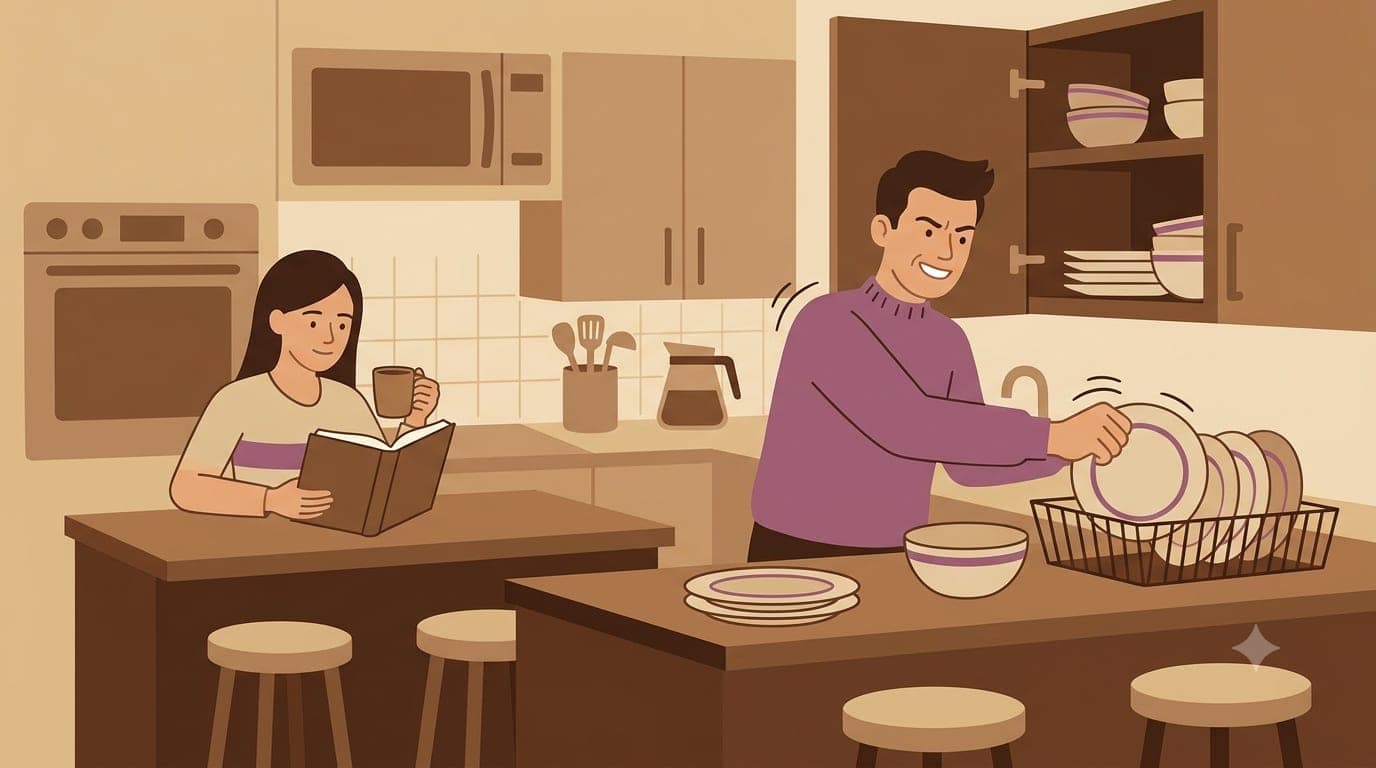
Passive-aggressive behavior is the indirect expression of anger by someone who can't or won't express it directly. It usually originates in families where anger was punished or unsafe. Common forms include sarcasm, 'forgetting,' weaponized incompetence, and the silent treatment. Responding to it requires naming the pattern without attacking the person, while recognizing it in yourself requires building the emotional vocabulary to say what you actually mean.
You ask your partner to take out the trash. They say "sure." Two days later, the trash is still there. You ask again. They say "I forgot." You take it out yourself, seething. They seem genuinely confused about why you're upset.
Or this: you bring up something that bothered you. Your partner says "fine, whatever you want," in a tone that clearly communicates the opposite of fine. You say "are you upset?" They say "no." Everything that follows has an edge to it. Doors close a little too firmly. Responses come a beat too late. But nothing is ever wrong. Nothing is ever said directly.
This is passive-aggression, and it's one of the most maddening dynamics in romantic relationships. Not because it's dramatic. Because it's invisible. You feel the hostility but you can't point to it. And when you try, you're told you're imagining things.
What actually is passive-aggressive behavior?
Scott Wetzler, a clinical psychologist at Albert Einstein College of Medicine, defined passive-aggression in his 1992 book Living with the Passive-Aggressive Man as "a deliberate and masked way of expressing covert feelings of anger." The key word is masked. Passive-aggressive behavior isn't the absence of anger. It's anger in disguise.
The Diagnostic and Statistical Manual (DSM) briefly included Passive-Aggressive Personality Disorder in earlier editions before removing it, partly because the construct was too broad and partly because the behavior exists on a spectrum. Most people who engage in passive-aggression don't have a personality disorder. They have a communication problem.
The defining feature is indirectness. The person is angry, hurt, or resentful, but they express it through behavior rather than words. The behavior is plausibly deniable: "I wasn't being sarcastic. You're too sensitive." "I didn't forget. I was busy." The deniability is the point.
What does passive-aggression look like in a relationship?
It takes many forms, and part of what makes it difficult to address is that each individual instance can be explained away. It's the pattern that reveals it.
Sarcasm as a delivery system. "Oh, I'm so sorry I loaded the dishwasher wrong." "Sure, go out with your friends again. I'll just be here." The hostility is real but wrapped in humor or irony that gives the speaker an exit. If you react, they say "I was just joking. Relax." This double move, expressing anger and then denying it in the same breath, is textbook.
Strategic forgetting. They agree to do something and then don't do it. Not once, which is normal human forgetfulness, but repeatedly, specifically around things that matter to you. The "forgetting" is selective. They remember everything about their own priorities and consistently fail to remember yours.
Weaponized incompetence. They do the task so badly that you stop asking. The laundry gets ruined. The dinner is inedible. The children are fed candy for dinner. When you complain, they shrug: "I tried. I guess you're just better at it." The goal, whether conscious or not, is to transfer the responsibility back to you by demonstrating that they can't be trusted with it.
The silent treatment. Withdrawal as punishment. Not the healthy "I need space to cool down" variety, which involves communication ("I'm overwhelmed and I need an hour before we continue this conversation"). The punitive variety, which involves disappearing emotionally with no explanation and no timeline. The silence says what the person won't: I'm angry, and I want you to feel it. The effects of the silent treatment on the receiving partner are well-documented and genuinely harmful.
Backhanded compliments. "You look great! I didn't think that dress worked on your body type, but it does." "Your presentation was really good for someone who hates public speaking." The praise is the wrapper. The dig is the content.
Chronic lateness and procrastination. Specifically targeted at things that matter to the partner. Being late to your parents' dinner. Taking weeks to handle a shared task that would take an hour. The passive-aggressive version is selectively directed at situations where the other partner has a stake.
Why do people become passive-aggressive?
This is where it gets more sympathetic, even though the behavior is frustrating.
Passive-aggression almost always originates in an environment where direct anger was unsafe. A childhood home where expressing anger was met with punishment, rejection, or a parent's emotional collapse. A family where conflict was either explosive and terrifying or completely forbidden. A cultural context where being "nice" was the highest virtue and having negative feelings was treated as a moral failing.
In these environments, a child learns: anger is dangerous. If I show it directly, something bad will happen. But the anger doesn't disappear. It can't. Anger is a fundamental human emotion that signals boundary violations, unmet needs, and perceived injustice. So it goes underground. It finds indirect channels. And those channels become habitual.
Tim Murphy and Loriann Hoff Oberlin, in their book Overcoming Passive-Aggression, describe the developmental trajectory: "The passive-aggressive person learned early that expressing anger directly would lead to negative consequences. So they developed a covert anger system that allows them to express hostility while maintaining a facade of compliance or agreeableness."
There's also an emotional literacy component. Some people are genuinely unaware of their own anger. They've suppressed it so thoroughly that they don't recognize it when it shows up. They genuinely believe they aren't angry, even as they slam cabinets and give one-word answers. The disconnect between what they feel and what they're aware of feeling is real, not performed.
This doesn't excuse the behavior. Understanding why someone does something doesn't obligate you to accept it. But it does change the approach. You're not dealing with someone who's trying to be cruel. You're dealing with someone whose anger learned to hide, and the hiding has become automatic.
How does the passive-aggressive cycle work?
There's a predictable pattern, and recognizing it is the first step toward breaking it.
Stage one: suppression. Something happens that upsets the passive-aggressive person. Maybe their partner said something dismissive. Maybe they felt controlled. Maybe they have a need they haven't expressed. Instead of acknowledging the feeling, they push it down. Everything is fine. No problem.
Stage two: resentment. The feeling doesn't go away. It sits and accumulates. Small grievances stack on top of each other. The person may not even be consciously tracking them, but the internal pressure is building.
Stage three: indirect expression. The anger leaks out sideways. A sarcastic comment. A "forgotten" task. A withdrawal of affection. The expression is indirect enough that the person can deny it (even to themselves) but direct enough that the partner feels it.
Stage four: partner confusion. The partner senses something is wrong but can't identify what. They ask. They're told nothing. The disconnect between what they're sensing and what they're being told creates anxiety and frustration. They might escalate, trying to force the issue into the open. Or they might withdraw themselves, creating distance.
Stage five: conflict. Eventually the tension breaks. The partner confronts the passive-aggressive behavior, often with more heat than the original issue warranted because weeks of accumulated confusion and frustration have made them reactive. The passive-aggressive person feels attacked and justified in their original suppression: "See? This is what happens when feelings come out."
And the cycle repeats. Each rotation deepens the pattern and erodes trust.
How do you respond to passive-aggression without making it worse?
The instinct is to call it out aggressively: "Stop being passive-aggressive!" This almost never works. It puts the person on the defensive and gives them something to push back against. Now the fight is about whether they were being passive-aggressive, not about what's actually wrong.
A better approach:
Name the behavior specifically, without labeling it. Instead of "you're being passive-aggressive," try "I noticed you said you were fine, but you've seemed distant since our conversation last night. I'd rather hear what's actually going on." This describes what you see without using language that feels like an accusation.
Make it safe to be direct. If your partner learned that direct anger is dangerous, your job is to demonstrate that it's safe with you. "I'd rather you tell me you're mad than have you go quiet on me. Even if it's hard to hear, I want the real version." And then, when they do express anger directly, respond well. Don't punish honesty by getting defensive. If you ask for directness and then blow up when you get it, you've confirmed their original fear.
Don't chase the denial. If they say "nothing's wrong" and something clearly is, say "okay, I'm here when you're ready to talk about it" and genuinely mean it. This respects their pace while keeping the door open.
Address the pattern, not just the instance. A single sarcastic comment isn't worth a State of the Union address. But if you've noticed a recurring dynamic, name it at a calm moment. "I've noticed that when something bothers you, you tend to go quiet instead of telling me. I want to understand why, and I want us to find a way where you can tell me the thing directly." Learning how to fight fair together means building an environment where directness is the norm, not the exception.
How do you recognize passive-aggression in yourself?
This is harder than recognizing it in your partner because the whole point of passive-aggression is that it operates below conscious awareness.
Some honest questions:
- Do you say "fine" when you don't mean it?
- Do you agree to things and then not follow through?
- Do you use humor to say things you won't say seriously?
- Do you withdraw affection when you're upset but deny that you're upset?
- Do you feel satisfaction when your partner notices you're unhappy, even though you've told them you're not?
If several of these are familiar, you're probably engaging in passive-aggressive behavior at least some of the time. And the path out isn't to shame yourself about it. It's to build the vocabulary and the safety to say what you mean.
This means practicing sentences like:
- "I'm actually angry about what happened earlier."
- "I said I was fine, but I'm not. I need to talk about this."
- "I don't want to do that, and I should have said so instead of agreeing."
These sentences feel risky because they're direct. And if your history taught you that directness is dangerous, they'll feel like stepping off a cliff. But in a healthy relationship, directness is the thing that builds trust. Your partner can't respond to needs they don't know about.
The broader communication guide covers how to build these skills systematically.
When is passive-aggression a sign of something deeper?
Occasional passive-aggression is normal. Everyone has moments where they're snappy, withdraw when hurt, or use sarcasm instead of saying what they mean. The concern is when it's the primary mode of expressing negative emotions. When anger never comes out directly. When needs are expressed only through their denial.
Chronic passive-aggression can indicate:
- Unresolved childhood patterns. If the behavior mirrors how one or both parents handled conflict, it's likely learned and deeply automatic.
- Depression. Irritability, withdrawal, and loss of motivation are depression symptoms that can look like passive-aggression.
- Relationship resentment. Sometimes it's the symptom of accumulated grievances that haven't been addressed. The person isn't constitutionally passive-aggressive. They've run out of direct ways to raise issues that keep being dismissed.
- A mismatch in emotional processing. Some people need more time to identify what they're feeling. What looks like evasion might be genuine confusion about their own internal state.
In any of these cases, the solution involves more than behavior modification. It involves understanding the function the behavior serves and finding healthier ways to meet that same need.
Aperi's double-blind answer format can help surface these dynamics. When both partners answer a question about conflict, anger, or needs independently, the passive-aggressive partner often reveals in writing things they struggle to say face-to-face. That written honesty becomes a bridge to verbal honesty over time. It's a low-stakes way to practice being direct.
Frequently asked questions
Is the silent treatment always passive-aggressive?
No. There's a meaningful difference between "I need space to calm down, and I'll come back to this in an hour" and disappearing emotionally for two days without explanation. The first is self-regulation with communication. The second is punishment through withdrawal. The marker is whether the person communicates what they need and provides a timeline. Healthy space has boundaries and an endpoint. Passive-aggressive silence is open-ended and designed to make you anxious.
My partner says they're "not angry" but clearly is. What do I do?
State what you observe, not what you interpret. "You say you're not angry, and I hear that. But you've been short with me all evening and I'm noticing a disconnect. I'd like to understand what's happening." This avoids telling them what they feel (which they'll deny) and instead describes the gap between what they're saying and what you're experiencing. If they continue to deny it, don't force the issue. Say you're available when they're ready and disengage from the dynamic.
Can passive-aggressive behavior be unlearned?
Yes, but it takes conscious effort over time because the behavior is deeply automatic. Most people who change this pattern do so through therapy (particularly cognitive-behavioral or psychodynamic approaches), through a partner who makes direct expression safe, or through enough relationship consequences that the behavior stops working. The central challenge is building comfort with direct emotional expression, which means tolerating the vulnerability and risk that directness involves.
How do I know if I'm actually being too sensitive or if my partner is really being passive-aggressive?
If you're asking this question, your instincts are probably onto something. Passive-aggression works precisely because it's deniable, which means the person on the receiving end is trained to doubt their own perceptions. Trust what your body is telling you. If you consistently sense hostility that's being denied, the pattern is the evidence. One instance could be misinterpretation. A repeated pattern over months or years is data.
What's the difference between passive-aggression and avoidant attachment behavior?
There's overlap. Avoidant attachment behavior involves pulling away from emotional intensity because closeness feels threatening. The person isn't angry. They're overwhelmed. Passive-aggression involves expressing anger through indirect channels. The person is angry but won't say so. The same behavior (withdrawal after conflict) can be either, and the distinction matters: avoidant withdrawal needs patience and space, while passive-aggressive withdrawal needs the anger to be surfaced and addressed.
Aperi: one question a day
A daily question app that adapts to you and your partner, and goes deeper the more you use it.


Free to start. Available on iPhone and Android.
Explore question packs
Related articles
Lack of communication in a relationship is rarely a skills problem
Lack of communication in a relationship: what the breakdown looks like in practice, what causes it (rarely skills), and the scripts that rebuild it.
The repair conversation: what to say after a big fight
The conversation after a fight matters more than the fight itself. Here is exactly how to have it.
Why most apologies don't work
Most apologies make things worse. What the research says about real repair attempts and why 'I'm sorry you feel that way' always fails.
Expressing your needs without starting a fight
Research-backed techniques for telling your partner what you need without triggering defensiveness or escalation.
12 rules for fighting fair
Conflict isn't the problem; how you fight is. Twelve research-backed rules for fighting fair, from soft startups to repair attempts.
How to have hard conversations without fighting
Soft startups, the speaker-listener format, repair attempts: tested techniques for hard conversations that don't turn into fights.