Key Takeaways
Military divorce rates are roughly similar to civilian rates, but the stressors are categorically different: deployment, relocation, PTSD, and reintegration create a cycle of separation and adjustment that most relationship advice doesn't address. Communication during deployment works best when it's scheduled and async rather than constant. Reintegration is often harder than the separation. Supporting a partner with combat-related trauma requires specific knowledge, not just love.
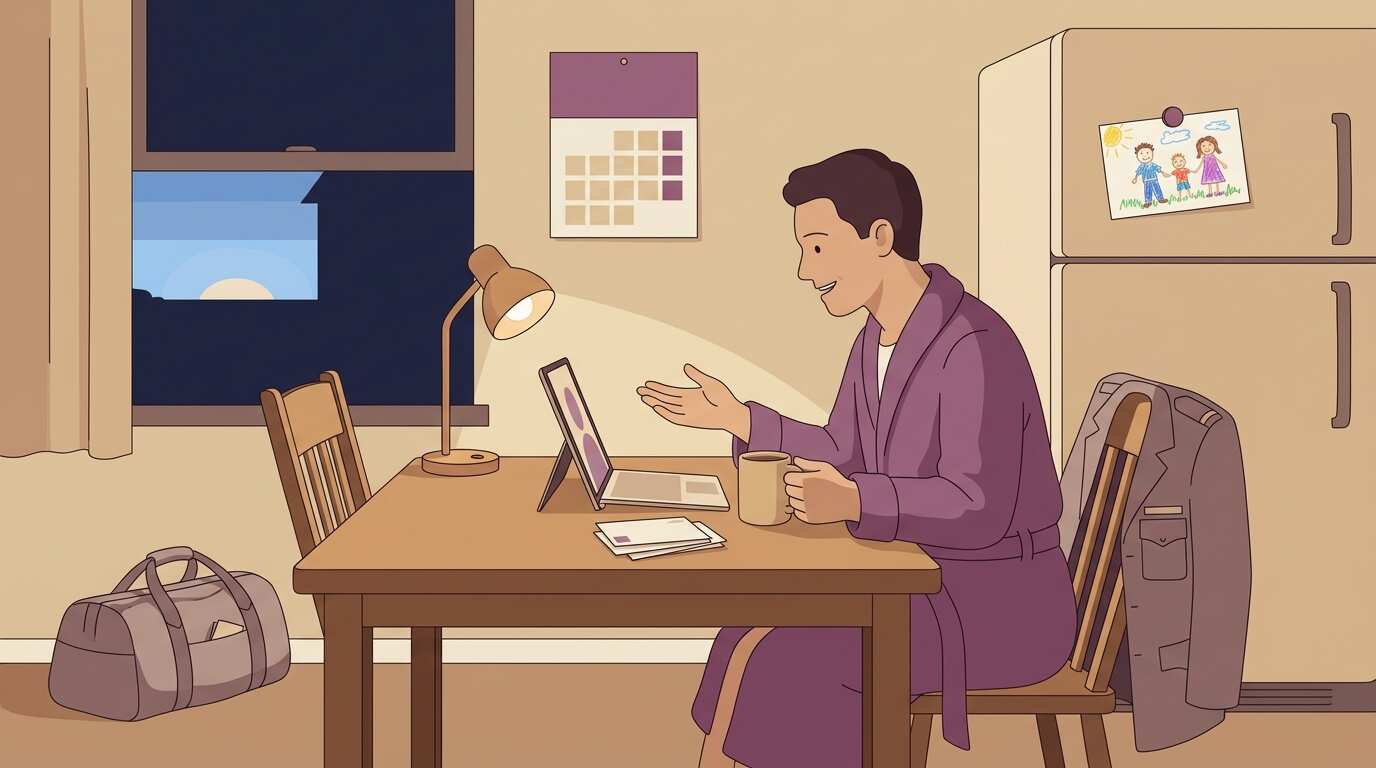
The goodbye is the part people see. The airport hug, the flag-waving send-off, the social media post about being proud of your service member. What people don't see is the six months of managing a household alone while pretending you're fine, the 2 AM anxiety when the news reports casualties in the region where your partner is deployed, or the strange, disorienting moment three weeks after they come home when you realize the person who came back isn't exactly the person who left.
Military relationships operate under pressures that civilian relationships don't. The advice that works for a couple navigating a normal rough patch often doesn't apply when one partner is on the other side of the world in a combat zone. The research on military families tells a specific story, and it's more complicated than "stay strong."
Are military relationships actually more likely to fail?
The popular assumption is yes. The reality is more mixed.
Benjamin Karney and John Crown conducted a landmark study for the RAND Corporation in 2007, analyzing Department of Defense data on military marriages. Their finding surprised a lot of people: military divorce rates were roughly comparable to civilian divorce rates when demographics were controlled. In some branches and during some periods, military rates were actually lower.
But "comparable divorce rates" doesn't mean "comparable experiences." The stressors are qualitatively different. Civilian couples fight about money, housework, and in-laws. Military couples fight about those things too, but they also deal with involuntary separations that last months or years, relocations that uproot their lives every 2-3 years, combat exposure that changes one partner's psychology, and a command structure that sometimes treats the family as secondary to the mission.
Karney and Crown also found that deployment itself had complicated effects. Short deployments didn't significantly increase divorce risk. Longer deployments, over 12 months, did, particularly when the service member was Army enlisted. And the effects weren't just during deployment. The period after return was often when the relationship was most vulnerable.
More recent research by Adrian Blow and colleagues (2017) found that it's not deployment frequency alone that predicts relationship outcomes but the combination of deployment stress, reintegration difficulty, and the couple's pre-deployment relationship quality. A strong relationship can survive deployment. A struggling one often can't.
What does the deployment cycle actually look like for the relationship?
Military psychologists describe a predictable emotional cycle that most military couples recognize.
Pre-deployment. This phase often starts weeks or months before the actual departure. Both partners know what's coming. The service member starts mentally preparing for the mission, which can look like emotional withdrawal. They're distancing because the goodbye is hard and because they need to shift their focus. The at-home partner may interpret this as coldness or loss of interest.
Some couples try to cram extra intimacy into this period. Others start arguing more, sometimes unconsciously, because it's easier to say goodbye to someone you're annoyed with than someone you're deeply connected to. Both patterns are normal and both are counterproductive. The couples who do best in this phase are the ones who acknowledge the weirdness directly rather than performing normalcy.
Deployment separation. The first few weeks are usually the worst. The at-home partner has to restructure their entire daily life: handling finances alone, parenting alone, maintaining the house alone, managing their own anxiety alone. The service member has to adapt to a completely different environment while worrying about home.
Then something that surprises many couples happens: the at-home partner gets good at it. They develop routines, confidence, competence. They handle things they used to rely on their partner for. This is healthy and necessary. It's also the seed of a problem that won't bloom until reintegration.
Reintegration. This is the phase that doesn't get enough attention. The homecoming itself is emotional and joyful. The weeks after are often the hardest period in the entire cycle.
The at-home partner has been running the household their way for months. They've made decisions, solved problems, established rhythms. Now the service member returns and wants to resume their role, but the role has been filled. The at-home partner doesn't want to give up the competence and autonomy they've built. The service member feels like a stranger in their own home.
Meanwhile, the service member may have experienced things they can't or don't want to talk about. They're readjusting to a world that seems absurdly trivial compared to where they've been. The at-home partner's complaints about the dishwasher or the neighbors feel meaningless after months of operational stress. The service member feels disconnected. The at-home partner feels shut out. Both people are grieving a version of their relationship that no longer exists.
This is the period when many military relationships break down, and it's not because anyone did anything wrong. It's because both people changed during the separation and the relationship they come back to isn't the one either of them left.
What actually works for communication during deployment?
This has changed dramatically with technology, and not entirely for the better.
In previous eras, military communication was limited to letters and occasional phone calls. This was painful but had an unintended benefit: it set realistic expectations. You couldn't talk every day, so you didn't. The letters you wrote were considered, intentional, complete.
Now, with video calls, texting, and social media, constant communication is technically possible. And many couples try for it, which creates its own problems.
Research by Faulk and colleagues (2012) found that the expectation of constant communication during deployment increased anxiety for both partners rather than reducing it. When the service member didn't respond to a text for hours, the at-home partner's mind went to worst-case scenarios. When the at-home partner shared a problem from home, the service member felt helpless and guilty. The connection that was supposed to be comforting became a source of stress.
What works better, according to both research and military family counselors:
Scheduled communication. A set time to talk, as regularly as operational requirements allow. This gives both partners something to look forward to and eliminates the anxiety of waiting for random contact.
Asynchronous depth. Letters, whether physical or email, that are longer and more reflective than a text. Questions that invite real answers rather than status updates. "What was the best part of your week?" produces a better exchange than "What are you doing?" This is where having a structured set of questions designed for long-distance couples can help fill the gap between calls.
Limited crisis communication. If something goes wrong at home (a car breaks down, a kid gets sick), the at-home partner benefits from having a support network to handle it rather than immediately calling the deployed partner. Not because the partner doesn't deserve to know, but because they can't actually help from 7,000 miles away, and knowing about a problem they can't solve adds stress without benefit.
Honest but calibrated sharing. The service member doesn't need to share combat details that will terrify the at-home partner. The at-home partner doesn't need to share every difficult moment that will make the service member feel guilty for being gone. This is appropriate filtering for the situation, not dishonesty. The full processing happens when they're back together.
What makes reintegration work?
Patience. Genuinely, that's the biggest factor.
The Military Family Research Institute at Purdue has studied reintegration extensively. Their findings consistently point to realistic expectations as the strongest predictor of successful reintegration. Couples who expect the homecoming to be perfect struggle more than couples who expect it to be awkward and effortful.
Specific strategies that help:
Go slow. Don't try to resume your pre-deployment relationship immediately. You're both different now. Give yourselves weeks, not days, to readjust. The service member needs time to acclimate to civilian rhythms. The at-home partner needs time to share their space and decision-making again.
Renegotiate roles explicitly. Don't assume the old division of labor still applies. Talk about who handles what now, based on current capabilities and preferences, not pre-deployment defaults. This is a particular version of the broader conversation about how to negotiate needs without fighting.
Expect emotional unevenness. Some days will feel close and connected. Some days will feel like you're living with a stranger. This is normal for the first several months. The unevenness isn't a sign of failure; it's a sign that two people who lived very different lives for an extended period are finding their way back to each other.
Get help early. Military OneSource, FOCUS (Families OverComing Under Stress), and Military Family Life Counselors are available at no cost and don't require a diagnosis. Using them is the equivalent of bringing a map to unfamiliar territory.
How do you support a partner with combat-related trauma?
This section needs directness. Combat-related PTSD and other trauma responses are common, serious, and misunderstood by civilians.
The National Center for PTSD estimates that between 11-20% of veterans who served in Iraq or Afghanistan have PTSD in a given year. Many more have sub-clinical symptoms (hypervigilance, sleep disruption, emotional numbing, irritability) that don't meet the diagnostic threshold but significantly affect relationships.
What the at-home partner needs to know:
The symptoms aren't about you. When your partner startles at a loud noise, can't sleep, is emotionally flat, or has an anger response that seems disproportionate, that's their nervous system responding to conditioning from a threat environment. It's not directed at you, even when it feels like it is.
You can't fix it. Love is not treatment. Your partner needs professional support: trauma-focused therapy, specifically. The two evidence-based treatments with the strongest track records for combat-related PTSD are Prolonged Exposure (PE) therapy and Cognitive Processing Therapy (CPT). Knowing those names means you can ask for them specifically rather than accepting generic "talk therapy" that may not address trauma.
Your own mental health matters. Secondary traumatic stress is real. Living with someone who has PTSD affects the partner's mental health too. Galovski and Lyons (2004) found that partners of veterans with PTSD reported higher rates of depression, anxiety, and relationship distress. Supporting a partner with mental health challenges requires that you also have support.
Don't avoid triggers; that makes it worse. Many couples develop elaborate avoidance patterns: don't go to crowded places, don't watch certain movies, don't talk about certain topics. While accommodating specific triggers is sometimes necessary in the short term, global avoidance reinforces the trauma response. Professional treatment works by gradually reducing avoidance, not increasing it.
What about the relocation problem?
Military families relocate every 2-3 years on average. This means the at-home partner, typically but not always the non-military spouse, loses their social network, their job, their community, and their routine repeatedly.
The career impact is measurable. A Blue Star Families survey found that military spouse unemployment hovers around 22%, not because these spouses lack qualifications but because frequent relocation makes career continuity nearly impossible. Some employers won't invest in training someone who'll leave in two years. Some careers require local licensing that doesn't transfer across states.
This creates a dependency dynamic that's different from civilian relationships. The at-home partner's financial independence, professional identity, and social connections are all disrupted by their partner's career. This can breed resentment, especially when the sacrifice feels one-directional.
Couples who manage relocations well tend to do two things: acknowledge the sacrifice explicitly and regularly (it's not "just part of being a military family," it's a real cost that deserves recognition), and build the at-home partner's portable identity through remote work, education, hobbies, and online communities that aren't location-dependent.
What stress does to relationships in general, and in military life specifically
All external stress affects relationships. Job loss, health crises, financial pressure. These things spill over into how partners treat each other. Military life concentrates multiple stressors simultaneously: separation, danger, relocation, role ambiguity, and social isolation. The cumulative effect is greater than any single stressor would predict.
Research on stress crossover in couples, how one partner's stress affects the other, applies with particular force to military relationships. The service member's operational stress affects the at-home partner's wellbeing. The at-home partner's loneliness and burden affect the service member's ability to focus on the mission. The system is connected, and pressure on any part of it travels.
The protective factor, consistently, is communication quality. Not quantity, but quality. Couples who can talk honestly about what they're experiencing, who ask each other real questions rather than surface-level check-ins, who admit when they're struggling. These couples handle military stress better than couples who perform toughness.
FAQ
Is couples therapy helpful for military relationships?
Yes, and the earlier the better. The Department of Defense now offers evidence-based couples therapy through military treatment facilities and programs like FOCUS. Gottman's research has been adapted specifically for military couples through the Gottman Method's military partnership program. The stigma around therapy in military culture has decreased significantly, though it hasn't disappeared. Using available resources isn't weakness; it's tactical.
How do we maintain intimacy during a long deployment?
Start by redefining intimacy for the deployment context. Physical intimacy is off the table, so emotional and intellectual intimacy need to fill the gap. Writing letters that share your inner life, not just your daily activities. Asking questions that go deeper than "how was your day?" Reading the same book and discussing it. Planning something together for after the return. Aperi's long-distance question feature was built with exactly this challenge in mind: maintaining a daily connection point when physical proximity isn't possible.
What do we do if our relationship was struggling before deployment?
Address it before the deployment if at all possible. Deployment doesn't pause relationship problems; it freezes them in place while adding new stress. Unresolved issues at departure will be waiting at return, plus the reintegration challenges on top. If pre-deployment counseling isn't available, at minimum have an honest conversation about where the relationship stands and agree on a plan for working on it during and after the deployment.
How do I explain military relationship stress to civilian friends?
You may not be able to, fully. Civilian friends who've never experienced deployment or relocation often can't grasp the specifics. What helps is concrete language rather than abstract claims. Instead of "it's just really hard," try "I haven't seen my partner in seven months and I'm running the household alone while worrying about their safety." Specific descriptions generate more empathy than general statements. And finding a military spouse community, in person or online, gives you people who understand without explanation.
Aperi: one question a day
A daily question app that adapts to you and your partner, and goes deeper the more you use it.


Free to start. Available on iPhone and Android.
Explore question packs
Related articles
When your partner travels for work
Work travel creates an asymmetry that regular long-distance advice ignores. What actually helps couples stay connected when one partner is always away.
What research says about long-distance relationships
Long-distance relationships get a bad reputation, but the research disagrees. What actually keeps couples connected across distance.
The couple's budget: managing money without resentment
Money is the #1 predictor of divorce, ahead of sex and in-laws. How to talk about it without someone sleeping on the couch.
Supporting your partner's dreams without losing yours
Great relationships help both people become their ideal selves. Here's how to support your partner without losing yourself.
Communication in marriage: how the years change the conversation
Communication in marriage erodes through efficiency, not conflict. What the years change, which patterns predict real trouble, and what daily practice looks like.
Lack of communication in a relationship is rarely a skills problem
Lack of communication in a relationship: what the breakdown looks like in practice, what causes it (rarely skills), and the scripts that rebuild it.