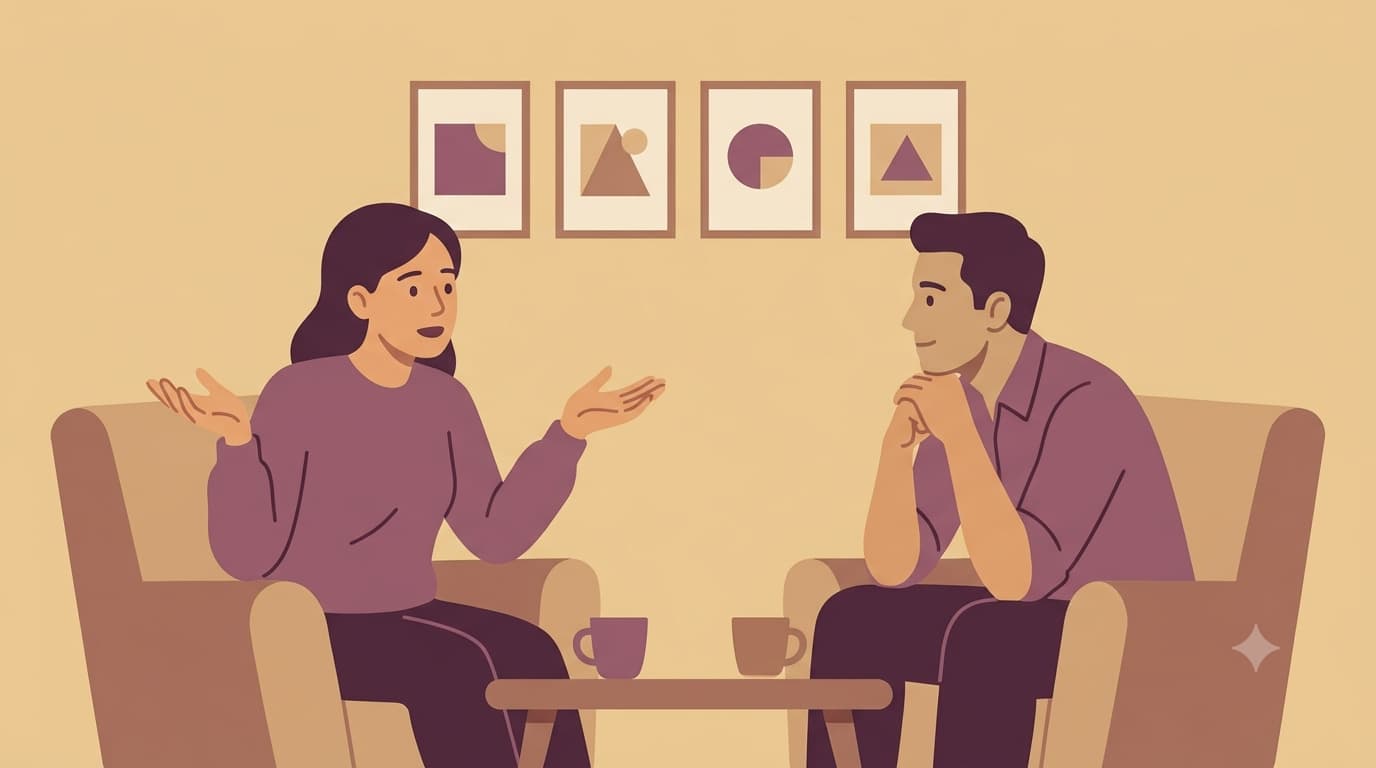
Key Takeaways
Most couples argue about topics. The style underneath the topic, passive, aggressive, passive-aggressive, or assertive, decides how the argument goes. This guide shows all four in the same ordinary scene, what happens when mismatched styles collide, and how to move toward assertive without sounding like a communication seminar.
Ask a couple what they fight about and you'll get topics: money, chores, in-laws, phones. Watch the same couple fight and you'll see something else, a pattern in how each person delivers and receives, that stays identical whether the topic is a credit card bill or a wet towel. Therapists have sorted those patterns into four classic styles: passive, aggressive, passive-aggressive, and assertive.
The framework is old, it comes out of the assertiveness training tradition of the 1970s, and it has survived because it keeps being useful. Style predicts the outcome of a conversation better than the topic does. Two assertive people can get through an affair conversation intact; a passive person and an aggressive person can turn a parking ticket into a cold war.
One caution before the tour: these are styles, not personality types. Nobody is "an aggressive person" in every room. Most of us are assertive when calm, and slide into one of the other three under stress. The question worth answering isn't "which one am I" but "which one do I become when it matters."
The four styles, in one ordinary scene
Same scene for all four. One partner came home an hour late, no text, and the other had dinner waiting. Watch what each style does with identical facts.
Passive goes quiet and absorbs it. "Oh, it's fine. I wasn't sure the recipe would work anyway." The feeling (hurt, worry, a flash of anger) is real but never surfaces, because the passive style prices conflict as more expensive than unmet needs. Nothing is resolved, because officially nothing happened. The cost arrives later, as distance, or as an eruption over something tiny three weeks on, which baffles the partner who was never told about the original ledger.
Aggressive leads with attack. "An hour late and you couldn't send one text? You never think about anyone but yourself." Notice the move from event to character: not "you didn't text" but "you are the kind of person who doesn't text." The underlying need (I want to matter, I was worried) is legitimate and completely inaudible, because the listener is now busy defending. Aggressive style wins exchanges and loses information; people stop telling you things.
Passive-aggressive expresses the anger while denying it's there. "Must be nice to have such a busy life." Then short answers all evening, a loud dishwasher loading, and "nothing" when asked what's wrong. The grievance is being communicated, that's the point of the sighing, but through a channel the sender can disavow. It offers the sender safety (I never said anything) at the price of ever being understood, and it hands the receiver an unsolvable puzzle: respond to the message and you're told it doesn't exist; respond to the words and you're punished for missing the message.
Assertive states the experience and makes a request. "I got worried when I didn't hear from you, and then honestly pretty annoyed. Can we agree you'll text if you'll be past seven?" The feeling is named, the event is described without a character verdict, and there's something concrete the other person can actually do. Assertiveness isn't niceness; it's directness plus respect, and it's the only one of the four styles that transmits the actual information.
Why do the other three styles exist at all?
Because each one works, locally. Passive avoids a fight tonight. Aggressive gets compliance now. Passive-aggressive discharges the feeling without the risk of stating it. Each style is a strategy that pays off in the moment and taxes the relationship over time, which is exactly why they persist. Nobody keeps a strategy that never works.
Most styles are inherited. If conflict in your childhood home meant shouting, you may have concluded that raising issues is an act of war, and gone passive. Or you learned that the loudest person wins, and went aggressive. Passive-aggressive tends to grow where anger was forbidden but feelings ran hot anyway. Knowing the origin doesn't excuse the style, but it usefully redirects the blame away from "my partner is broken" toward "my partner learned a bad strategy from people who also learned it."
What happens when styles collide?
Styles don't operate in a vacuum. They pair up, and some pairings have predictable physics.
Aggressive meets passive and the relationship develops a steamroller dynamic. One person's volume grows because they never get resistance, the other's silence deepens because resistance feels dangerous. From the outside it looks peaceful. Inside, the passive partner is keeping a ledger, and the aggressive partner will one day be blindsided by "I've been unhappy for years," having genuinely never heard a complaint.
Aggressive meets aggressive and everything escalates fast, though this pairing is more survivable than it looks, because at least the information is on the table. The danger is contempt creeping in. Gottman's research names contempt the strongest predictor of divorce among his Four Horsemen, and repeated aggressive exchanges are where contempt is manufactured.
Passive meets passive produces the quietest failure mode: two people being considerate at each other while the relationship starves. No fights, no feedback, no course corrections. Couples in this pairing often report feeling like polite roommates and can't point to anything that went wrong, because nothing was ever allowed to.
Passive-aggressive meets anyone creates a fog. Paired with a literal-minded partner, the hints sail past entirely, which the sender reads as further proof of not being cared about. Paired with an anxious partner, the fog breeds constant decoding: what did that sigh mean, why the short answers. Sustained long enough, the withdrawal side of this style shades into stonewalling, which does documented damage of its own. If this fog is your daily weather, the pattern has a fuller anatomy worth reading.
The pattern across all of these: mismatched styles train each other. The steamroller gets louder because the mouse gets quieter, and the mouse gets quieter because the steamroller gets louder. Which is also the good news. If the styles trained each other into the pattern, changing one side changes the system.
How do you move toward assertive without becoming a robot?
People resist assertiveness training for a fair reason: the scripted version sounds like nobody you'd want dinner with. "I feel disappointed when agreements are not honored." Fine in a workbook, alienating at the kitchen counter. The goal isn't to talk like a mediator. It's to keep your natural voice while changing three specific habits.
First, say the thing. This is the whole move for passive and passive-aggressive styles. Not diplomatically, not eventually, not through a sigh: out loud, to the person, near the time it happened. If you need training wheels, the guide to expressing needs without a fight breaks the wording down, but wording is secondary. The habit being built is that needs get spoken.
Second, describe events, not character. This is the whole move for the aggressive style. "You didn't text" is an event your partner can fix. "You're inconsiderate" is a verdict they can only appeal. Keep the heat if you must, plenty of healthy couples argue loudly, but aim it at the situation. The line you're trying not to cross is the one where your partner stops hearing a complaint and starts hearing a character reading, at which point you'll be talking to their defenses instead of them.
Third, attach a request. Complaints without requests are weather; requests give your partner a way to win. "Can we agree you'll text after seven" converts an hour of grievance into a five-second fix.
And when you're on the receiving end of a non-assertive style, name the pattern gently rather than prosecuting it. To a passive partner: "I get the sense something's off, and I'd genuinely rather hear it than guess." To an aggressive one, mid-flight: "I want to hear this, and I can't while it's at this volume. Can we restart?" You're not responsible for fixing your partner's style, but you can stop feeding it.
Style change is a practice problem more than an insight problem, which is why reading this far is the smaller half of the work. The communication exercises guide has the drills; the broader communication guide covers the surrounding terrain.
A low-stakes place to practice saying real things
Assertiveness has a prerequisite that rarely gets named: you have to know what you feel and want before you can state it. Daily self-disclosure builds exactly that muscle. Aperi gives couples one question each day, matched to the two of you, and neither answer is revealed until both are in, so you write yours without adjusting for your partner's. It starts with easy questions and moves deeper as your comfort builds, which makes it a daily rep of the core assertive skill, saying a true thing plainly, in a setting where nothing is on fire.
FAQ
What are the four communication styles in relationships? Passive (needs suppressed to avoid conflict), aggressive (needs expressed as attacks or demands), passive-aggressive (needs expressed indirectly through hints, sarcasm, and withdrawal, while being denied outright), and assertive (needs stated directly with respect for the other person). Most people have a calm-state style and a different stressed-state style, and the stressed one shapes conflicts.
Which communication style is healthiest? Assertive, and not as a matter of taste: it's the only style that transmits what you feel and what you want in a form the other person can act on. Passive hides the information, aggressive buries it under threat, and passive-aggressive encrypts it. Assertiveness does require more upfront courage than the others, which is why the unhealthy styles remain popular.
Can two people with different communication styles have a good relationship? Yes, and most couples are mismatched in some direction. What matters is whether the styles are drifting toward assertive or reinforcing each other's worst versions, like the loud-quiet spiral where an aggressive partner and a passive partner each make the other more extreme. A mismatch that both people can name and joke about is usually a mismatch under repair.
How do I change my communication style? Identify your stress style honestly, then practice its specific antidote in low-stakes moments: passive and passive-aggressive people practice stating small preferences out loud, aggressive people practice describing events without verdicts and attaching requests. Expect the new behavior to feel unnatural for weeks, and practice when nothing is wrong, because a real argument is the worst classroom.
Aperi: one question a day
A daily question app that adapts to you and your partner, and goes deeper the more you use it.


Free to start. Available on iPhone and Android.
Explore question packs
Related articles
Communication in marriage: how the years change the conversation
Communication in marriage erodes through efficiency, not conflict. What the years change, which patterns predict real trouble, and what daily practice looks like.
Lack of communication in a relationship is rarely a skills problem
Lack of communication in a relationship: what the breakdown looks like in practice, what causes it (rarely skills), and the scripts that rebuild it.
50 couples therapy questions, in the order a therapist would ask them
50 couples therapy questions sequenced like a real session: history, patterns, needs, repair, future. Plus an honest look at when a list is not enough.
When you and your partner speak different love languages
You show love your way, not theirs. How to close the gap when you and your partner express affection differently, beyond the quiz.
Working with your partner: boundaries that save your relationship
When your partner is also your colleague, role confusion and power dynamics can erode the relationship. How to set boundaries that protect both.
When your partner travels for work
Work travel creates an asymmetry that regular long-distance advice ignores. What actually helps couples stay connected when one partner is always away.