
Key Takeaways
Defensiveness is one of Gottman's Four Horsemen because it shuts down productive conflict every single time. Your brain treats your partner's complaint like a physical threat, but the antidote is surprisingly simple: take even partial responsibility. The hard part is catching yourself before the defense reflex fires.
Your partner says, "You forgot to call the dentist again." Before the sentence is finished, your brain has already assembled a defense. You didn't forget. You were busy. They could have called. They forgot something last week too. You have a whole case ready to present, and you haven't even processed what they actually said yet.
This is defensiveness. It's fast, automatic, and it feels completely justified in the moment. It also makes every argument worse. Every single time.
Why does defensiveness feel so natural?
Because your brain is trying to protect you.
Naomi Eisenberger's 2003 research at UCLA showed that social rejection and physical pain activate the same neural regions. Specifically, the dorsal anterior cingulate cortex and the anterior insula light up whether you stub your toe or feel criticized by someone you love. Your brain doesn't make a clean distinction between "my partner is unhappy with me" and "I'm under attack."
This means when your partner raises a complaint, your nervous system can respond the same way it would to a physical threat: fight, flight, or freeze. Defensiveness is the fight response. Your body mobilizes to protect you from danger that isn't actually dangerous.
John Gottman identified defensiveness as one of the Four Horsemen of relationship communication, the patterns that predict relationship failure with startling accuracy. The reason it's so destructive isn't that it's hostile. It's that it communicates something specific to your partner: "Your feelings don't matter, and I refuse to consider that I played any role in this."
That message lands hard, even when you don't intend it.
What does defensiveness actually look like?
Most people think defensiveness means arguing back. That's one version. But defensive responses take several forms, and some of them look nothing like aggression.
Counter-attacking. Your partner says they felt hurt that you didn't introduce them to your coworkers at the party. You respond: "Well, you spent the whole time on your phone, so maybe you should think about your own behavior." The complaint gets deflected back. Nothing gets addressed.
Playing the victim. "I do everything around here and nobody appreciates it. I can't believe you're coming at me about this one thing." This reframes the situation so that you're the injured party. Your partner's concern disappears beneath your suffering.
"Yes, but"-ing. "Yes, I said I'd handle it, but you changed the timeline, and I had that work thing, and the kids needed help with homework..." Technically, you're acknowledging the issue. Functionally, you're explaining why it's not your fault. Your partner hears a wall of excuses.
Bringing up the past. "Oh, like you were so great when you forgot my mom's birthday?" This is called kitchen-sinking, and it derails the conversation into a scorekeeping battle that nobody wins. The original issue? Gone.
Intellectualizing. "I think what's really happening here is that you're projecting your work stress onto me." Cool analysis. Zero accountability. And it tends to make the other person want to throw something.
What is your partner's complaint actually about?
Most defensive people miss this: complaints aren't usually about the surface issue.
When your partner says "you never help with dinner," they probably aren't conducting a statistical analysis of your dinner contributions. They're expressing something underneath: I feel alone in this. I feel like the household falls on me. I want to feel like we're a team.
When they say "you're always on your phone," the real message might be: I miss you. I want your attention. I feel less important than whatever's on that screen.
Defensiveness blocks you from hearing the deeper message. You get stuck arguing about the factual accuracy of "always" and "never" while the actual feeling goes unaddressed. Your partner walks away feeling unheard, and you walk away feeling attacked. Both of you are right about your own experience, and both of you are missing the other's.
The Gottman method calls this "turning toward" your partner's bid for connection rather than turning away from it. A complaint, however clumsily delivered, is often a bid. It's saying: something is wrong between us and I want it to be better. Defensiveness says: no it isn't, and if it is, it's your fault.
How do you catch yourself before the defense fires?
The gap between trigger and response is small. A few hundred milliseconds. But it exists, and you can learn to widen it.

Notice the physical signals first. Defensiveness starts in the body before it reaches your mouth. Your chest tightens. Your jaw clenches. Your shoulders come up. You might feel heat in your face or a surge of energy in your arms. These signals arrive before the defensive words form. If you can learn to recognize "my body is going into defense mode," you've created a tiny space to choose a different response.
The pause. Once you notice the physical activation, pause. Don't respond yet. Take one breath. It doesn't need to be a dramatic deep-breathing exercise. One normal breath, consciously taken, is enough to shift from reactive mode to responsive mode. What you're doing neurologically is giving your prefrontal cortex time to come back online after the amygdala hijack.
The self-talk. In that pause, ask yourself one question: "Is there any part of this that's true?" Not all of it. Not even most of it. Just any part. If your partner says you've been distant lately, is there a 10% chance they have a point? If the answer is yes, that 10% is your way in.
Name what's happening internally. Research by Matthew Lieberman at UCLA (2007) found that simply labeling an emotion reduces its intensity. Saying to yourself "I'm feeling attacked right now" paradoxically makes you less reactive than trying to suppress the feeling. You can even say it out loud: "I'm noticing I want to defend myself right now. Give me a second."
What does a non-defensive response sound like?
The antidote to defensiveness, according to Gottman's research, is taking responsibility. Not total, groveling, self-flagellating responsibility. Partial responsibility. Acknowledging the piece that's yours.
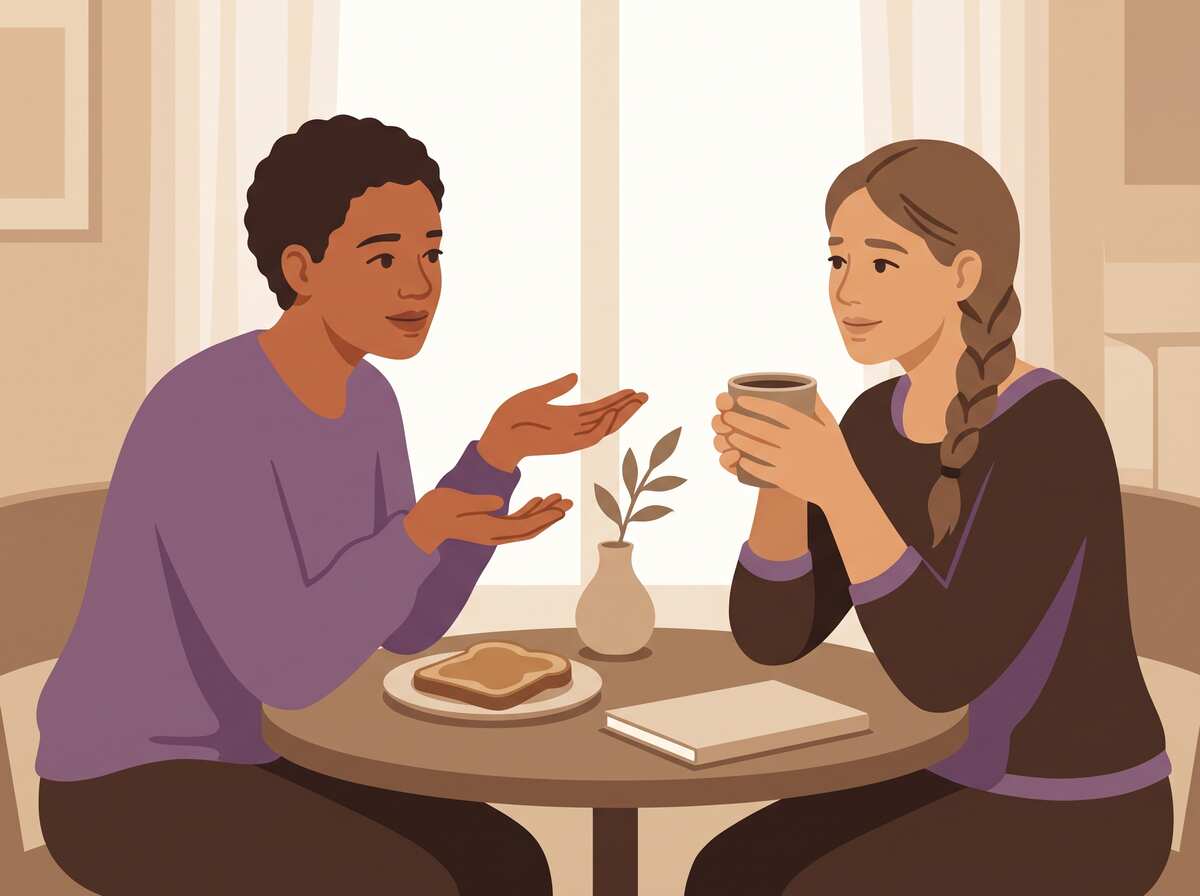
The difference:
Defensive: "I didn't forget. I've been dealing with a million things and you could have called too."
Non-defensive: "You're right, I did say I'd call and I didn't follow through. That's on me. I'll do it tomorrow morning."
Defensive: "I'm not distant! We literally watched a movie together last night."
Non-defensive: "I have been pretty wrapped up in work this week. I can see how that feels like I'm not present. What would help?"
Defensive: "You're the one who spends money on stuff we don't need."
Non-defensive: "Yeah, that purchase was more than we agreed on. I should have talked to you first."
Notice what the non-defensive responses don't do: they don't require you to agree with everything your partner said. They don't require you to be wrong about everything. They pick out the piece that's true and acknowledge it. That's enough to shift the entire dynamic of the conversation.
Your partner isn't looking for you to be perfect. They're looking for you to hear them. Taking responsibility for even a small piece of the issue communicates: I take your experience seriously, and I'm willing to look at my own behavior.
Can you be non-defensive and still disagree?
Yes, and this is where people get stuck. They think the choice is between defending themselves and becoming a doormat. It's neither.
You can disagree without being defensive. The difference is sequence. A non-defensive disagreement starts with acknowledgment and then offers a different perspective:
"I hear that you felt ignored at the party. That wasn't my intention, and I'm sorry it landed that way. From my side, I was trying to network for the promotion, and I thought we'd talked about that beforehand. Can we figure out how to handle these situations better?"
This validates your partner's feeling, takes responsibility for the impact, shares your perspective without attacking, and proposes a solution. It's not submissive. It's mature. And it actually leads somewhere, unlike a defensive volley that just escalates.
If you want to fight fair, this is the single most important skill to develop. Most productive conflict resolution starts with at least one person choosing not to be defensive.
What if you're always the one being told to stop being defensive?
Pay attention to whether the pattern goes one direction. If your partner constantly raises complaints and you're always the one expected to take responsibility, that's not a defensiveness problem. That's a fairness problem.
Healthy relationships involve both people being willing to hear feedback and both people being willing to own their part. If one partner is doing all the complaining and the other is doing all the accommodating, the dynamic has drifted into something worth examining more closely.
There's also a difference between defensiveness and having a legitimate boundary. If your partner's "complaints" are actually criticism of who you are as a person, if they attack your character rather than address specific behavior, your defensive response might be a reasonable reaction to contempt. Not all complaints are fair. Not all feedback is delivered well.
The question to sit with: Am I defensive because I don't want to hear this, or because this isn't being said in a way I can hear?
When defensiveness signals something deeper
Some people are defensive about everything. Small feedback, big feedback, compliments that feel like backhanded criticism, neutral observations that somehow feel like attacks. If your defensiveness is pervasive rather than situational, it's worth asking where it started.
Chronic defensiveness often traces back to environments where criticism was constant, where mistakes were punished rather than corrected, or where you learned that any admission of fault would be used against you. If you grew up with a parent who catalogued every mistake and brought them up repeatedly, you learned that acknowledging any error was dangerous. That template gets carried into adult relationships, even when your partner is nothing like that parent.
Childhood experiences shape adult relationship patterns in ways that aren't always obvious. If your defensiveness feels disproportionate to the situation, if a gentle "hey, you left the milk out" triggers the same internal response as a full-on attack, individual therapy can help you trace the wiring back to its source and update it.
A practice to try this week
The next time your partner raises a complaint, try the non-defensive response exercise:
- Listen without preparing your rebuttal. Just hear what they're saying. Let the words land.
- Pause. One breath.
- Find the kernel of truth. Even if it's small.
- Acknowledge that piece out loud. "You're right that I..."
- Ask what they need. "What would help here?"
It will feel wrong the first few times. Your body will scream that you're leaving yourself unprotected. That feeling is your nervous system running old software. The new software says: I'm safe enough to hear this, and my relationship is more important than winning this argument.
This is about being the kind of partner who can hear hard things without treating them as warfare, not about being a pushover. And that's a skill, not a personality trait. You can build it.
If you find yourself stuck in the same defensive patterns, Aperi's daily questions give you a structured way to practice hearing your partner's perspective. Each day, both of you answer independently before seeing each other's response, which builds the habit of sitting with your own reaction before responding. It's a small practice, but defensiveness is beaten in small moments, not grand gestures.
FAQ
Is defensiveness always bad?
Not always. There's a difference between reflexive defensiveness that shuts down conversation and a measured defense of yourself when you're being treated unfairly. If your partner is engaging in contempt, name-calling, or character attacks, pushing back isn't defensiveness. It's self-respect. The problem is when defensiveness is your default response to any feedback, even when it's delivered gently and accurately.
How do I respond when my partner is defensive?
Don't tell them they're being defensive. That almost always makes it worse. Instead, try softening your approach. Check whether your complaint started with "you always" or "you never," which triggers defense in most people. Reframe it as a feeling: "I felt hurt when..." rather than "You did this wrong." If they're still too activated to hear you, take a break and return to the conversation later.
Can couples therapy help with defensiveness?
Yes, and it's often the fastest route. A trained therapist can spot defensive patterns in real time and interrupt them, which is hard to do on your own when you're emotionally activated. Methods like the Gottman approach and Emotionally Focused Therapy (EFT) specifically address the defensive cycle and help both partners understand what's happening beneath the surface.
What's the difference between defensiveness and gaslighting?
Defensiveness is a protective reaction. You're trying to avoid feeling wrong. Gaslighting is a deliberate pattern of making your partner question their own reality: "That never happened," "You're too sensitive," "You're imagining things." Defensive people typically feel bad after a fight. Gaslighters don't, because the goal isn't self-protection. It's control. If your partner consistently denies things you know happened, that's a different problem than defensiveness.
When you're ready to practice hearing each other without the armor, Aperi gives you a daily question that both of you answer before seeing what the other said. It's a low-stakes way to build the muscle of listening without defending.
Aperi: one question a day
A daily question app that adapts to you and your partner, and goes deeper the more you use it.


Free to start. Available on iPhone and Android.
Explore question packs
Related articles
The silent treatment: what it does to your brain and your bond
The silent treatment activates the same brain regions as physical pain. Here's what the research says about why it happens and how to stop the cycle.
What is stonewalling, and what to do when your partner shuts down
When your partner shuts down mid-argument, it's usually not a choice. Why stonewalling happens, what's going on physically, and how to break it.
Lack of communication in a relationship is rarely a skills problem
Lack of communication in a relationship: what the breakdown looks like in practice, what causes it (rarely skills), and the scripts that rebuild it.
When you and your partner speak different love languages
You show love your way, not theirs. How to close the gap when you and your partner express affection differently, beyond the quiz.
The Zeigarnik effect: why unfinished conversations haunt your relationship
Why unresolved conflicts keep looping in your head, and how to close the open loops that create resentment.
ADHD and relationships: what both partners need to know
ADHD doesn't just affect focus. It reshapes relationship dynamics in ways both partners need to understand to stop the blame cycle.