Key Takeaways
Couples who barely speak usually communicated fine at the start, so the skills exist. What changed is that somewhere along the way, honesty got expensive. This is a guide to spotting the breakdown early, understanding what caused it, and making talking cheap again, with scripts.
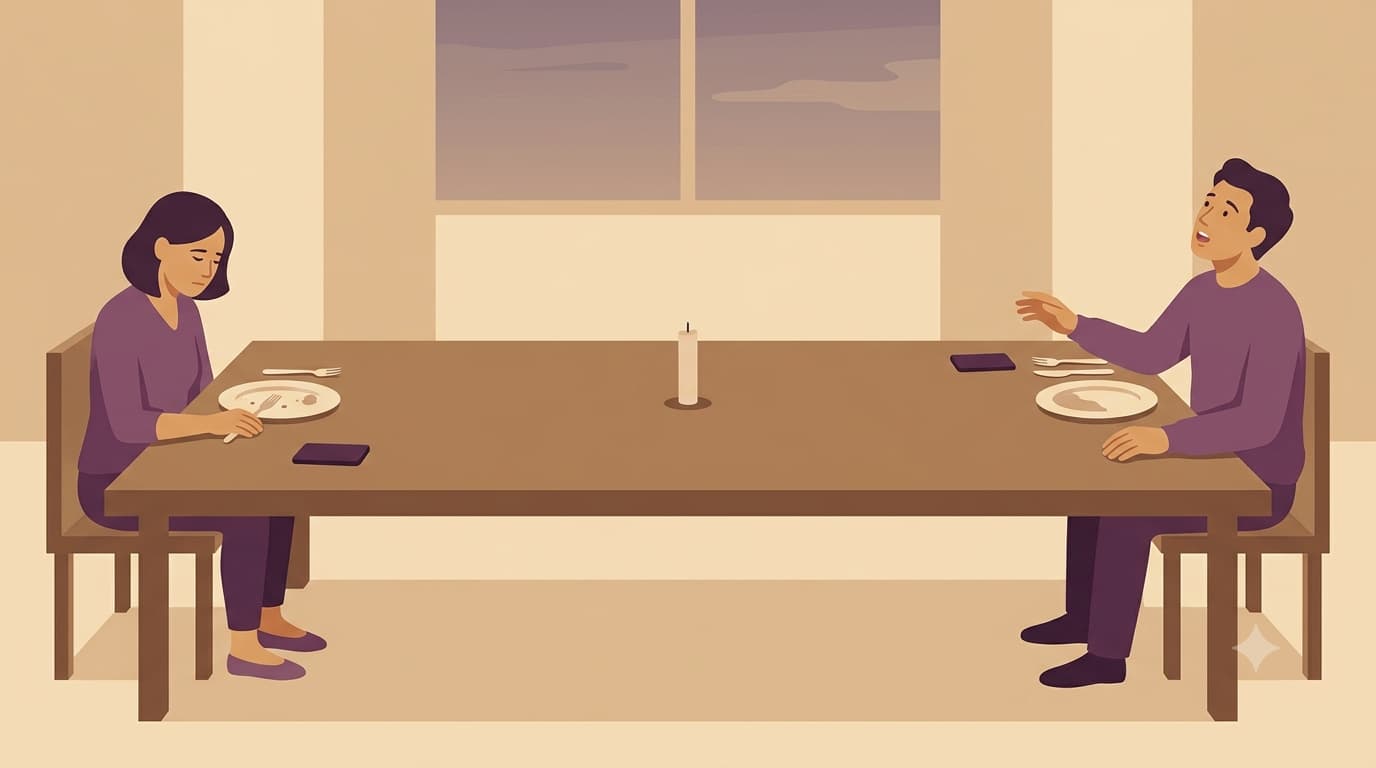
Two people who once stayed up talking until 3am now sit through dinner in a silence that isn't the comfortable kind. When couples describe this stage, they reach for the same phrase almost every time: we have a communication problem. And the internet agrees, offering listening techniques and conversation frameworks as if the issue were technical.
But notice something. These same two people used to talk for hours. The skills exist; they're just not being used. What changed is the economics: somewhere along the way, talking started to cost more than it paid.
That reframe matters, because if you treat a safety problem with technique, you get compliance theater. Two people deploying excellent active listening on topics that don't matter, while everything real stays unsaid.
What a communication breakdown looks like in practice
"No communication in a relationship" almost never means literal silence. It has more specific shapes:
- Conversation is logistics only: kids, calendar, groceries, whose turn it is.
- You hear about important things late, or from someone else entirely.
- Questions get one-word answers, and following up feels like interrogation.
- You rehearse conversations in your head instead of having them, and the rehearsal is the only version that ever runs.
- Disagreement has gone underground. Instead of arguments there's silence, or an agreement neither of you means.
- You notice a small flinch before raising anything, and you catch yourself timing topics: after dinner, not before; Saturday, not Tuesday.
- One or both of you is more honest with friends than with each other.
Notice what these signs of poor communication share: none of them is a skills gap. Every one is avoidance, and avoidance always has an object. Something specific is being avoided.
What causes it, if it isn't skills
The most common cause is punished honesty. Every couple runs an invisible ledger. Each time raising something led to a real conversation, honesty got cheaper; each time it led to a blow-up, a dismissal, or a mood that lasted two days, honesty got more expensive. Nobody decides to stop talking. They just lose enough rounds that silence becomes the rational move. The slow-burn version of this is common enough that it has its own anatomy.
The second cause is flooding. Gottman's team documented that during conflict, some people (men disproportionately) become physiologically overwhelmed: heart rate climbs, thinking narrows, and the person shuts down mid-conversation. From the outside it looks like refusal. From the inside it feels like drowning. Gottman calls the chronic form stonewalling, one of his four predictors of divorce. It's worth separating from the deliberate version: the silent treatment is punishment, stonewalling is overwhelm, and they need different responses even though they look identical at the dinner table.
The third is the resentment backlog. Once enough unresolved material accumulates, every topic becomes load-bearing. You can't discuss the dishwasher, because the dishwasher connects to the mental load, which connects to that thing from two years ago that never got repaired. Both of you can feel the tripwires, so both of you stop walking through that part of the house.
The fourth is plain atrophy. Not every breakdown is about conflict. Some couples simply optimize their way into silence: shorthand replaces sentences, prediction replaces curiosity, and after enough years the talking muscle is out of shape. No fear, no resentment, just efficiency doing what efficiency does.
And the fifth is mismatched processing. One partner thinks out loud and wants the conversation now; the other needs a day to know what they feel. Left unnamed, the fast one experiences the slow one as withholding, the slow one experiences the fast one as an ambush, and both learn to avoid starting.
Diagnosis matters because the fixes differ. Atrophy needs practice. Punished honesty needs safety. Flooding needs structure. Most stuck couples need some of each.
How to rebuild it
Everything that works runs on one principle: make honesty cheap again.
Start by naming the pattern without blame. Not "we need to work on our communication," which sounds like a performance review, but something closer to: "I've noticed we mostly talk about logistics lately. I miss talking to you. Can we do ten minutes tonight, no kids, no calendar?" The important moves are in the framing: the drift is described as a thing that happened to both of you, and the motive is missing them rather than charging them.
Then shrink the stakes. The rebuilding conversations should be short, low-pressure, and frequent. Ten minutes on a walk beats a two-hour summit, because the summit raises the cost of honesty right when you're trying to lower it.
Open gently when something is at stake. Conversations tend to end the way they begin, so the first sentence is worth composing. "I feel stretched thin when the planning lands on me, can we look at the week together?" opens a different conversation than "you never plan anything." The mechanics of clean openers are covered in I-feel statements, and the broader toolkit in the communication guide.
Receive honesty well, even when it stings. This is the step everyone skips. If you ask for openness and then argue with what arrives, you've paid for another six months of silence. The response that keeps the channel open costs one sentence: "thank you for telling me, I want to understand this." Rebuttals can wait a day; they usually shrink overnight anyway.
And install the pause. For the flooding-prone, agree on a script before it's needed: "I want to have this conversation and I can't do it well right now. Give me an hour and I'll come back to it." The return time is what separates a legitimate pause from stonewalling with better PR. The pause is a right; the comeback is the rent on it.
When it's past the DIY stage
If contempt has entered the picture, if the silence has lasted months despite genuine invitations, or if every attempt above detonates on contact, you're past the range where scripts help. That's not a verdict on the relationship; it's a signal that the pattern now needs a third person to interrupt it. Couples therapy is built for exactly this, and couples who go early tend to need far less of it.
Removing the going-first problem
One reason silence persists is that someone has to go first, and going first is the expensive part. A neutral prompt removes that cost. Aperi gives the two of you one question a day, chosen for where you are as a couple, and neither answer becomes visible until both are written. Nobody initiated, so nobody is exposed, and the questions start light and deepen only as your comfort does. For a couple rebuilding the habit, it's a daily rep with the risk taken out.
FAQ
Can a relationship survive without communication? It can persist, but persistence and health aren't the same thing. Couples can run on logistics for years, especially with children or busy careers as cover. The cost shows up at the first real stressor (a job loss, an illness, an empty nest), when there's no working channel left to process it together. Survival is also the wrong bar: the silence itself is usually lonelier than either partner admits.
How do you fix lack of communication in a relationship? Lower the cost of honesty instead of adding techniques. Name the drift without blame, keep early conversations short and frequent, open difficult topics gently, receive whatever honesty you get without punishing it, and use agreed pauses instead of shutdowns. Daily low-pressure exchanges rebuild the habit faster than occasional big talks, which tend to raise the stakes rather than lower them.
What are the signs of poor communication in a marriage? Logistics-only conversation, one-word answers, hearing important news secondhand, silence where disagreement used to be, conversations rehearsed but never had, and honesty flowing to friends instead of to each other. The unifying sign is a felt cost: if either of you hesitates before raising ordinary things, communication is already breaking down, whatever the daily word count looks like.
Is lack of communication a reason to break up? By itself, usually not, because it's a symptom with several causes and most of them respond to deliberate effort. The better question is whether both people are willing to make talking cheaper: to invite honesty and then not punish it. If one partner declines to engage for months despite clear, gentle invitations, that refusal is the real issue, and it deserves a direct conversation, possibly with professional help.
Aperi: one question a day
A daily question app that adapts to you and your partner, and goes deeper the more you use it.


Free to start. Available on iPhone and Android.
Explore question packs
Related articles
Passive-aggressive behavior in relationships
Passive-aggression isn't about dishes left in the sink. It's anger that learned to hide. How to spot it, respond to it, and stop doing it yourself.

The repair conversation: what to say after a big fight
The conversation after a fight matters more than the fight itself. Here is exactly how to have it.

Why most apologies don't work
Most apologies make things worse. What the research says about real repair attempts and why 'I'm sorry you feel that way' always fails.

Expressing your needs without starting a fight
Research-backed techniques for telling your partner what you need without triggering defensiveness or escalation.
12 rules for fighting fair
Conflict isn't the problem; how you fight is. Twelve research-backed rules for fighting fair, from soft startups to repair attempts.

How to have hard conversations without fighting
Soft startups, the speaker-listener format, repair attempts: tested techniques for hard conversations that don't turn into fights.